Research projects
My scientific life so far concentrated on the detailed modelling of the nuclear distribution of gas and dust
with various modelling approaches.
During my Diploma and Phd thesis in Prof. Meisenheimer's group at the Max-Planck-
Institute for Astronomy (Heidelberg, Germany), the main goal of my work was to provide models of AGN tori with the help of
hydrodynamic simulations in combination with radiative transfer calculations for the direct comparison to observations,
mainly with the MIDI instrument.
During my postdoc
position in Prof. Burkert's Physics of Galactic Nuclei group,
we concentrated on the detailed micro physics happening in the direct vicinity of black holes.
Recently, I also got interested in the physics of the Galactic Centre region and especially in
the evolution of the gas cloud G2. I am also involved in a project
where we numerically study the evolution of
clumpy high redshift galaxies. In Prof. Jeremy Mould's group, I am
working on RAMSES simulations to model the circum-nuclear gas
structures in nearby early-type galaxies.
On this page, a short overview over our research work is given (in inverse chronological order).
If you have any questions
please do not hesitate to contact me.
Giant clumps are actually clump clusters!
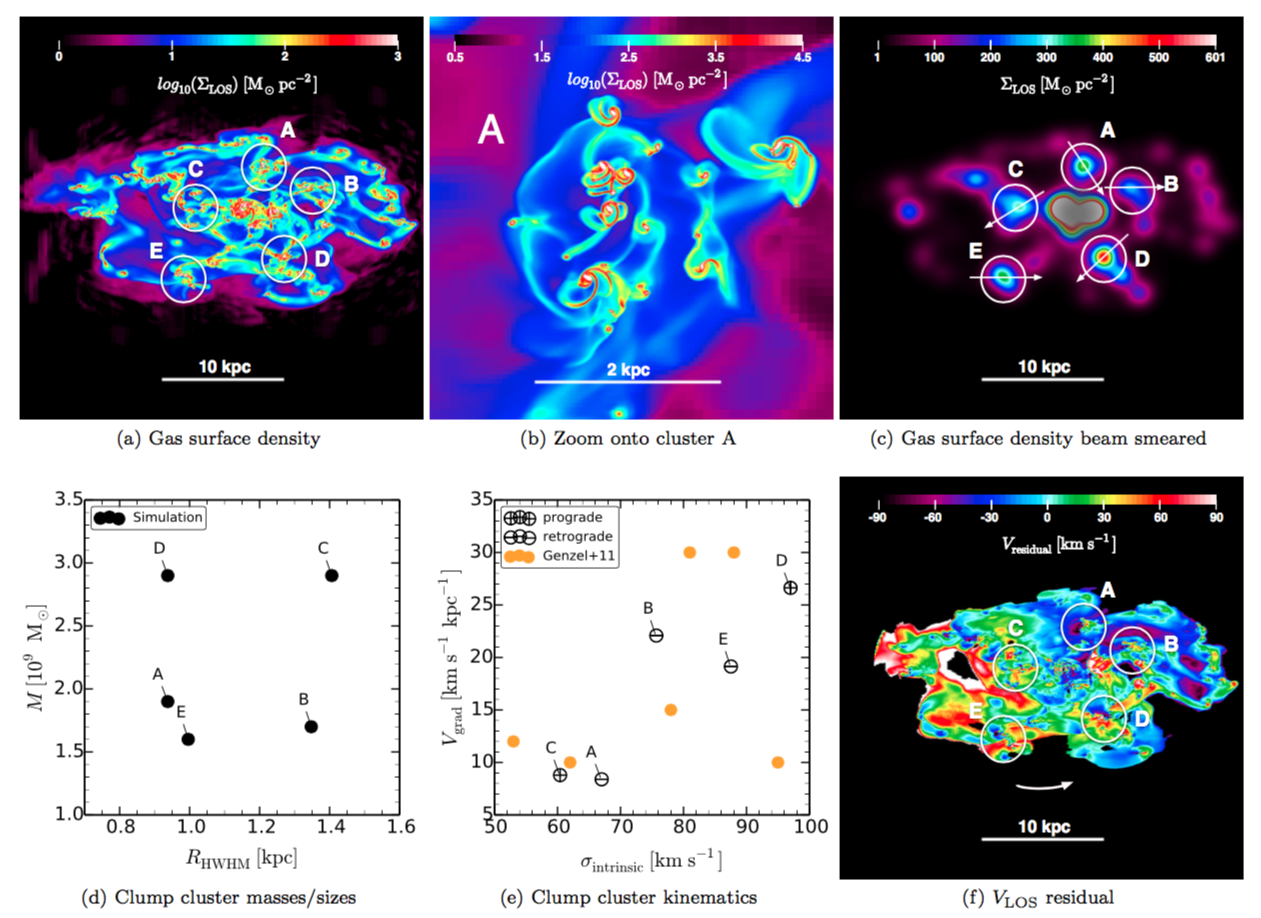 Giant clumps are a characteristic feature of observed high-redshift disc galaxies. We propose that
these kpc-sized clumps have a complex substructure and are the result of many smaller clumps self-organising
themselves into clump clusters (CC).
Using a high resolution hydrodynamical simulation of an isolated, fragmented massive gas disc and mimicking the
observations from Genzel et al. (2011) at z∼2, we find remarkable agreement in many details.
This might indeed necessitate a paradigm shift in the high-z clump formation community.
Giant clumps are a characteristic feature of observed high-redshift disc galaxies. We propose that
these kpc-sized clumps have a complex substructure and are the result of many smaller clumps self-organising
themselves into clump clusters (CC).
Using a high resolution hydrodynamical simulation of an isolated, fragmented massive gas disc and mimicking the
observations from Genzel et al. (2011) at z∼2, we find remarkable agreement in many details.
This might indeed necessitate a paradigm shift in the high-z clump formation community.
Behrendt, Burkert, Schartmann, 2016, ApJL, accepted
Stellar feedback efficiencies: supernovae versus stellar winds
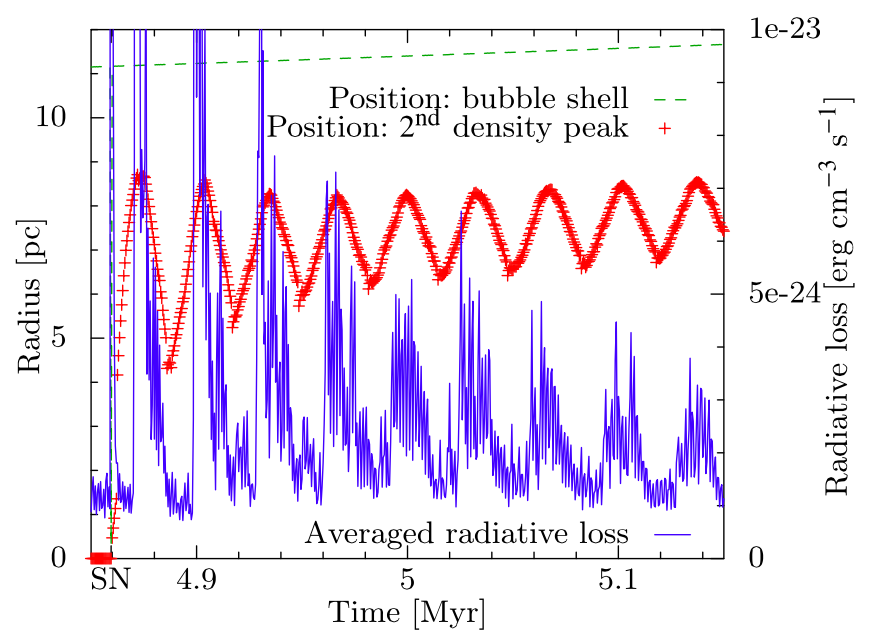 Stars impact their surrounding gas by injecting kinetic energy in form of winds and supernova
explosions. What is their relative contribution to stirring the ISM?
One dimensional spherically symmetric PLUTO simulations give us the answer: Taking into account
the stellar wind phase prior to the supernova explosion increases the amount of kinetic energy
deposited in the cold ISM from 0.1 per cent to a few per cent of the feedback energy.
Stars impact their surrounding gas by injecting kinetic energy in form of winds and supernova
explosions. What is their relative contribution to stirring the ISM?
One dimensional spherically symmetric PLUTO simulations give us the answer: Taking into account
the stellar wind phase prior to the supernova explosion increases the amount of kinetic energy
deposited in the cold ISM from 0.1 per cent to a few per cent of the feedback energy.
Fierlinger, Burkert, Ntormousi, Fierlinger, Schartmann, Ballone, Krause, Diehl, 2016, MNRAS, 456, 710
Clump formation by colliding stellar winds
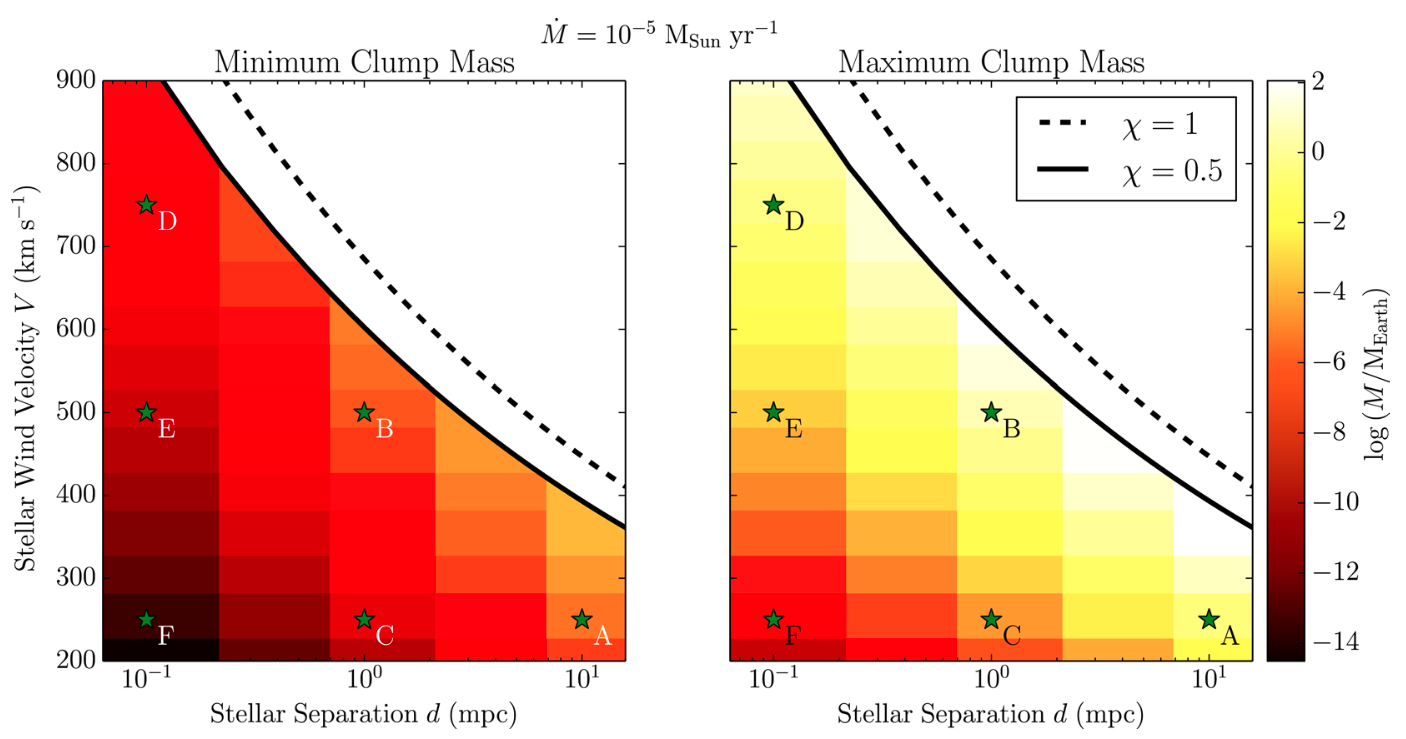 Can clumps similar to the Galactic Centre cloud G2 be formed by colliding winds? As the possible origin
of G2 is consistent with a location within the discs of young Wolf-Rayet stars, we investigate whether
the Non-Linear Thin Shell Instability (NLTSI) is a candidate for producing such mass condensations. Using
analytical estimates, we find that the best candidates are the collisions from
slow stellar winds (≲750 km s-1) with high mass loss rates (˜10-5 M⊙
yr-1) which reach short separations (<10mpc). However, within the GC environment this can only be achieved by
binary systems like e.g. IRS 16SW.
Can clumps similar to the Galactic Centre cloud G2 be formed by colliding winds? As the possible origin
of G2 is consistent with a location within the discs of young Wolf-Rayet stars, we investigate whether
the Non-Linear Thin Shell Instability (NLTSI) is a candidate for producing such mass condensations. Using
analytical estimates, we find that the best candidates are the collisions from
slow stellar winds (≲750 km s-1) with high mass loss rates (˜10-5 M⊙
yr-1) which reach short separations (<10mpc). However, within the GC environment this can only be achieved by
binary systems like e.g. IRS 16SW.
Calderon, Ballone, Cuadra, Schartmann, Burkert, Gillessen 2016, MNRAS, 455, 4388
Is G2 coming from within the disc(s) of young stars?
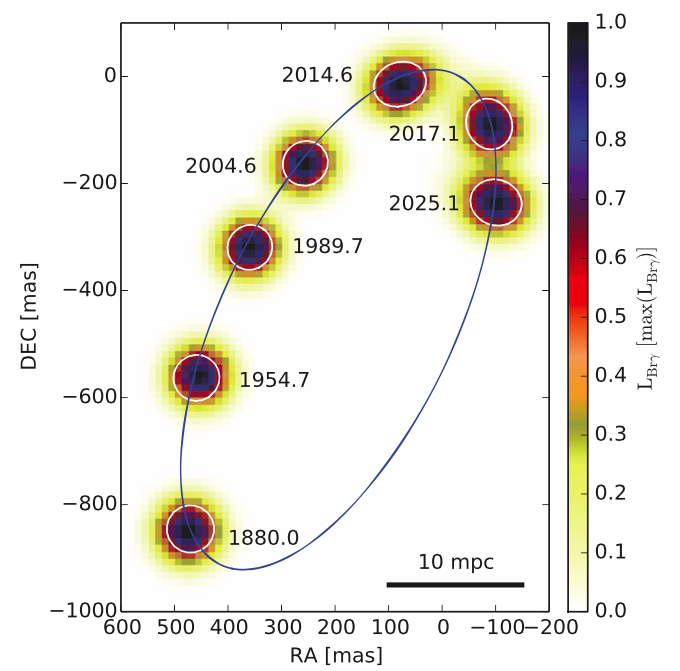 Using 3D hydrodynamical adaptive mesh refinement (AMR) simulations with the PLUTO code, we investigate
the possible origin, evolution and fate of the Galactic Centre cloud G2.
From the simulation data, we produce mock observations of the Brackett gamma emission. Together with
the velocity information this allows for a detailed comparison to observed position-velocity
diagrams and the time evolution of the Brackett gamma luminosity. This reveals that a starting point
of the cloud within the disc(s) of young stars is most likely when following the observed orbit.
Using 3D hydrodynamical adaptive mesh refinement (AMR) simulations with the PLUTO code, we investigate
the possible origin, evolution and fate of the Galactic Centre cloud G2.
From the simulation data, we produce mock observations of the Brackett gamma emission. Together with
the velocity information this allows for a detailed comparison to observed position-velocity
diagrams and the time evolution of the Brackett gamma luminosity. This reveals that a starting point
of the cloud within the disc(s) of young stars is most likely when following the observed orbit.
Schartmann, Ballone, Burkert, Gillessen, Genzel, Pfuhl, Eisenhauer, Plewa, Ott, George, Habibi 2015, ApJ, 811, 155
Insights into the dusty and neutral torus
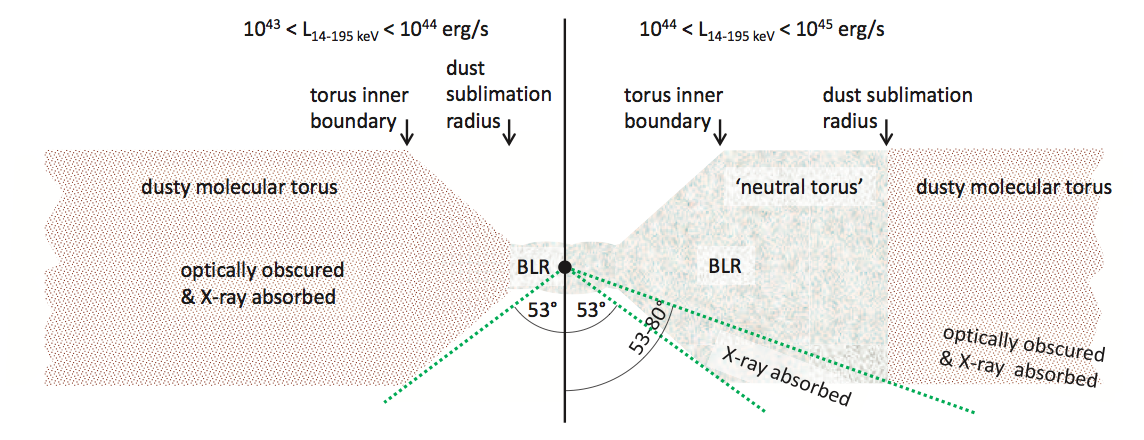 A complete volume limited sample of nearby
active galaxies selected by their 14-195keV
luminosity is presented, which - together with a matched inactive
sample - will be used to study the mechanisms regulating gas inflow
and outflow.
The obscured fractions are analysed and put into perspective with
other available samples.
This suggests that the torus does not strongly evolve with redshift
and that X-ray unabsorbed Seyfert 2s are rare, comprising not more than a
few percent of the Seyfert 2 population. At higher luminosities, the
optically obscured fraction decreases (as expected for the increasing
dust sublimation radius), but the X-ray absorbed fraction changes
little. It seems that the cold X-ray absorption in these Seyfert 1s
can be accounted for by neutral gas in clouds that also contribute to
the broad line region (BLR) emission;
and suggest that a geometrically thick neutral gas torus co-exists
with the BLR and bridges the gap to the dusty torus.
A complete volume limited sample of nearby
active galaxies selected by their 14-195keV
luminosity is presented, which - together with a matched inactive
sample - will be used to study the mechanisms regulating gas inflow
and outflow.
The obscured fractions are analysed and put into perspective with
other available samples.
This suggests that the torus does not strongly evolve with redshift
and that X-ray unabsorbed Seyfert 2s are rare, comprising not more than a
few percent of the Seyfert 2 population. At higher luminosities, the
optically obscured fraction decreases (as expected for the increasing
dust sublimation radius), but the X-ray absorbed fraction changes
little. It seems that the cold X-ray absorption in these Seyfert 1s
can be accounted for by neutral gas in clouds that also contribute to
the broad line region (BLR) emission;
and suggest that a geometrically thick neutral gas torus co-exists
with the BLR and bridges the gap to the dusty torus.
Davies, Burtscher, Rosario, Storchi-Bergmann, Contursi, Genzel, Graciá-Carpio, Hicks, Janssen, Koss, Lin, Lutz, Maciejewski, Müller-Sánchez, Orban de Xivry, Ricci, Riffel, Riffel, Schartmann, Schnorr-Müller, Sternberg, Sturm, Tacconi, Veilleux, S. 2015, ApJ, 806, 127
Gravitational instabilities in gas-rich high-redshift galaxies
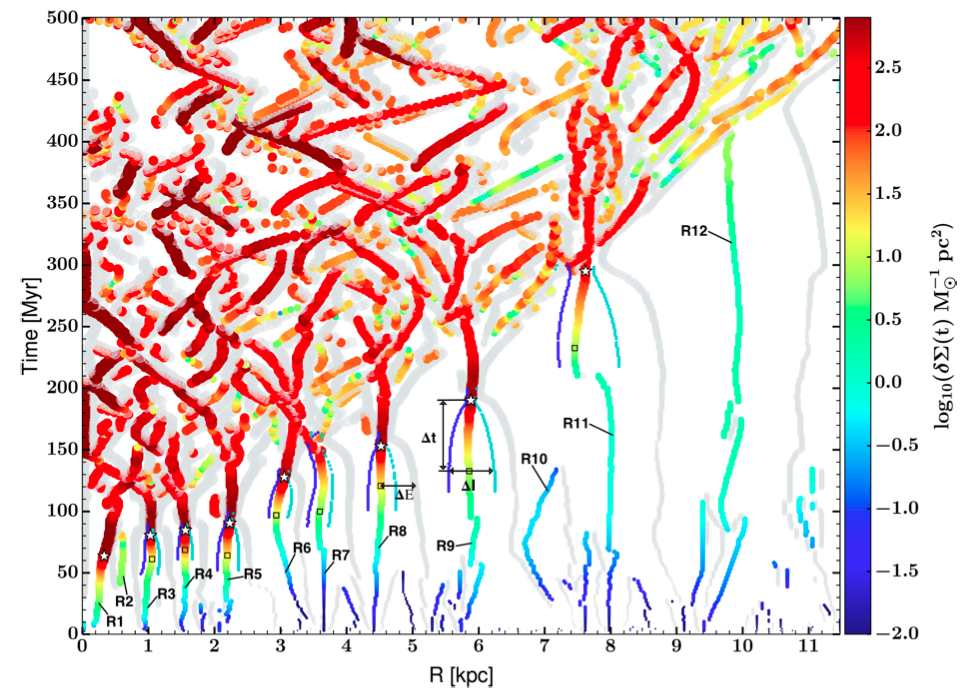 Gravitational instabilities play an important role in structure
formation of gas-rich high-redshift disc
galaxies.
We revisit the axisymmetric perturbation theory
and the resulting growth of structure by taking
the
realistic thickness of the disc into account.
The analytical theory is tested by comparing to a high-resolution
hydrodynamical simulation of an isothermal
gravitationally unstable gas disc. The expected break up into rings -
which organize themselves discretely with
distances corresponding to the local fastest
growing perturbation wavelength - is
analysed in detail.
These rings later on contract to a thin and dense line, while at the same time accreting more gas from the inter-ring region. It is these dense, circular filaments, that subsequently fragment into a large number of clumps.
Gravitational instabilities play an important role in structure
formation of gas-rich high-redshift disc
galaxies.
We revisit the axisymmetric perturbation theory
and the resulting growth of structure by taking
the
realistic thickness of the disc into account.
The analytical theory is tested by comparing to a high-resolution
hydrodynamical simulation of an isothermal
gravitationally unstable gas disc. The expected break up into rings -
which organize themselves discretely with
distances corresponding to the local fastest
growing perturbation wavelength - is
analysed in detail.
These rings later on contract to a thin and dense line, while at the same time accreting more gas from the inter-ring region. It is these dense, circular filaments, that subsequently fragment into a large number of clumps.
Behrendt, Burkert, Schartmann, 2015, MNRAS, 448, 1007
G2 is not alone!
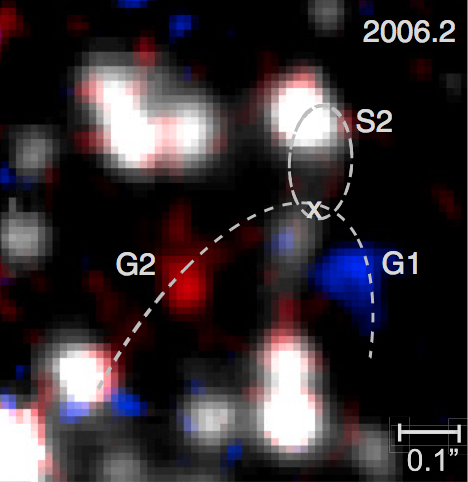 New deep NIR SINFONI @ VLT IFU data of the gas cloud G2 in the
Galactic Center is presented, which tracks the
ongoing tidal disruption.
Roughly half of the gas in 2014 is found at the redshifted,
pre-pericenter side of the orbit, while the other half is at
the post-pericenter, blueshifted side. We also
present an orbital solution for the gas cloud
G1, with almost identical orientation of the orbit compared to G2,
but with lower eccentricity and smaller semi-major axis. This could
indicate that G1 was originally on a very similar orbit (but
preceding G2 by 13 years) and suffered
from hydrodynamical interaction with the surrounding atmosphere when
reaching the direct vicinity of the massive black hole.
G2, its tail and G1 may, therefore, be bright knots in a much more
extensive gas streamer.
New deep NIR SINFONI @ VLT IFU data of the gas cloud G2 in the
Galactic Center is presented, which tracks the
ongoing tidal disruption.
Roughly half of the gas in 2014 is found at the redshifted,
pre-pericenter side of the orbit, while the other half is at
the post-pericenter, blueshifted side. We also
present an orbital solution for the gas cloud
G1, with almost identical orientation of the orbit compared to G2,
but with lower eccentricity and smaller semi-major axis. This could
indicate that G1 was originally on a very similar orbit (but
preceding G2 by 13 years) and suffered
from hydrodynamical interaction with the surrounding atmosphere when
reaching the direct vicinity of the massive black hole.
G2, its tail and G1 may, therefore, be bright knots in a much more
extensive gas streamer.
Pfuhl, Gillessen, Eisenhauer, Genzel, Plewa, Ott, Ballone, Schartmann, Burkert, Fritz, Sari, Steinberg, Madigan 2015, ApJ, 798, 111
Time-resolved IR emission from central obscuring structures
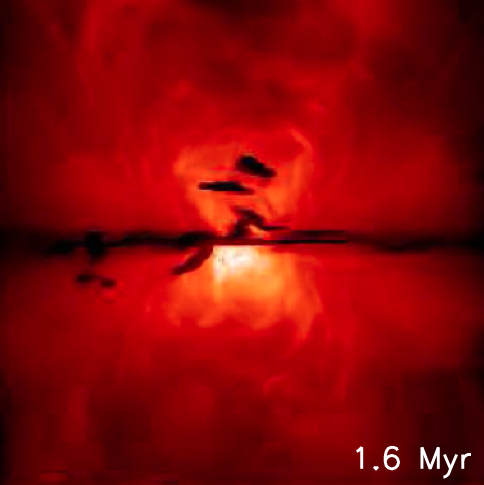
Observable properties are derived for a self-consistent radiation-hydrodynamical model of a toroidal gas and dust structure, where the geometrical thickness is achieved and maintained with the help of X-ray heating and radiation pressure due to the central engine. Time-resolved SEDs and images are obtained with the help of dust continuum radiative transfer calculations with RADMC-3D. We find good agreement with observed characteristics, especially for those models, which show clear outflow cones in combination with a geometrically thick distribution of gas and dust, as well as a geometrically thin, but high column density disc in the equatorial plane. Dramatic differences are visible depending on wavelength: whereas the mid-infrared images are dominated by the elongated appearance of the outflow cone, the long wavelength emission is mainly given by the cold and dense disc component.
Schartmann, Wada, Prieto, Burkert, Tristram, 2014, MNRAS, 445, 3878
The influence of extinction in the central parsecs of active galactic nuclei
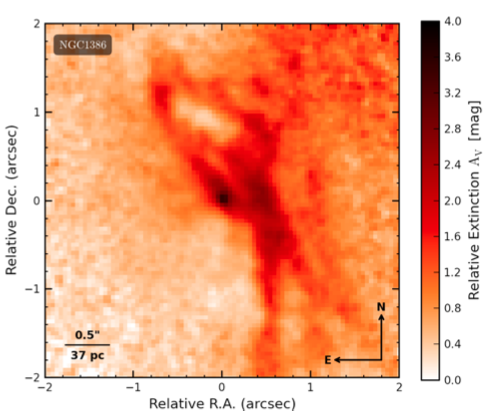
Very accurate registration of infrared VLT and HST images is used to identify the precise location of the nucleus. Dust extinction maps of the central few kpc of these galaxies are constructed allowing to trace the dust morphology at scales of few pc. We find that in almost all cases, the IR nucleus is shifted by several tens of pc from the optical peak and its location is behind a dust filament providing additional extinction along the line of sight. Some of the obscuring structures nicely connect to structures identified on kpc scale, which might suggest that these are the fueling channels.
Prieto, Mezcua, Fernandez-Ontiveros, Schartmann, 2014, MNRAS, 442, 2145
The dusty torus in the Circinus galaxy: a dense disc and the torus funnel
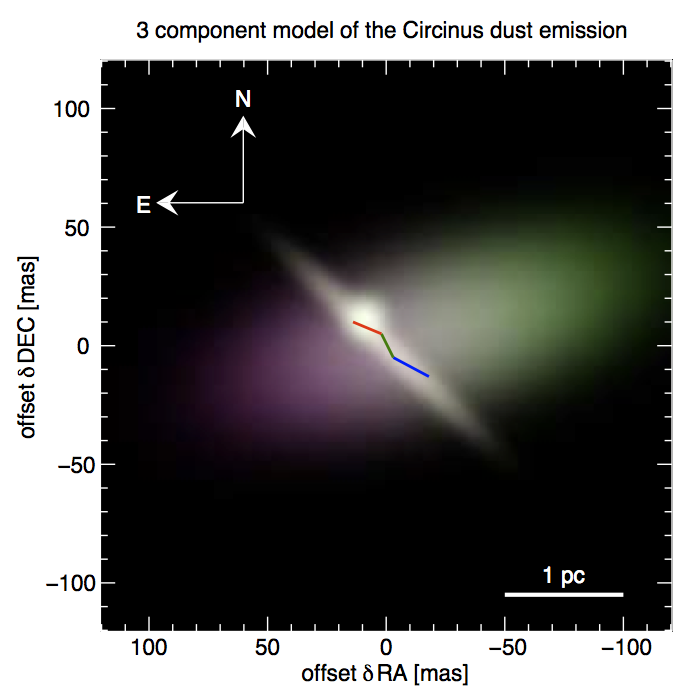
With the help of 152 correlated flux spectra and differential phases between 8 and 13 micron taken with the MIDI instrument at the VLTI, we are able to better constrain the dust morphology in the closest Seyfert 2 nucleus - the Circinus galaxy. The data is best modelled with two black-body emitters with a Gaussian brightness distribution and with dust extinction: a disc-like emission component with a size (FWHM) of ∼ 0.2 × 1.1 pc (perpendicular to the ionisation cone) and an extended component with a size of ∼ 0.8 × 1.9 pc (roughly perpendicular to the disc-component and responsible for 80% of the MIR emission). The latter is interpreted as being emission from the inner funnel of an extended dust distribution. Both components have a temperature of roughly 300K.
Tristram, Burtscher, Jaffe, Meisenheimer, Hönig, Kishimoto, Schartmann, Weigelt, 2014, A&A, 563, 82
A diversity of dusty AGN tori: The VLTI/MIDI AGN Large Programme
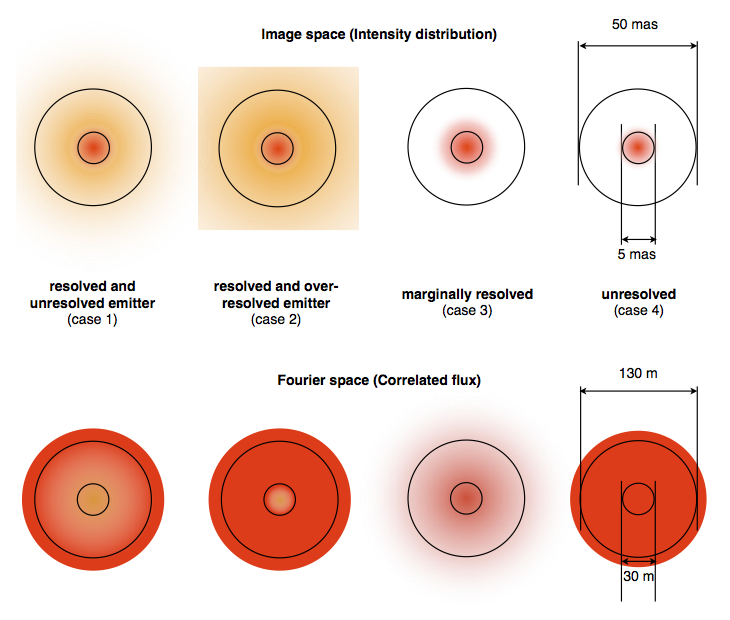
A total of 16 new interferometric observations from the MIDI AGN Large Program (2009–2011) are presented in combination with a compilation of archival data as well as VLT/VISIR fluxes. Correlated and total fluxes, as well as size estimates at 12 micron are derived for 23 AGNs using simple axisymmetric geometrical models. Perhaps the most surprising result is the relatively high level of unresolved flux and its large scatter: The median “point source fraction” is 70% for type 1 and 47 % for type 2 AGNs meaning that a large part of the flux is concentrated on scales <5 mas (0.1–10 pc). For 18 of the sources, two nuclear components can be distinguished in the radial fits and eight show significant elongations.
Burtscher, Meisenheimer, Tristram, Jaffe, Hönig, Davies, Kishimoto, Pott, Röttgering, Schartmann, Weigelt, Wolf, 2013, A&A, 558, 149
Observing G2's pericenter passage in the Galactic Center
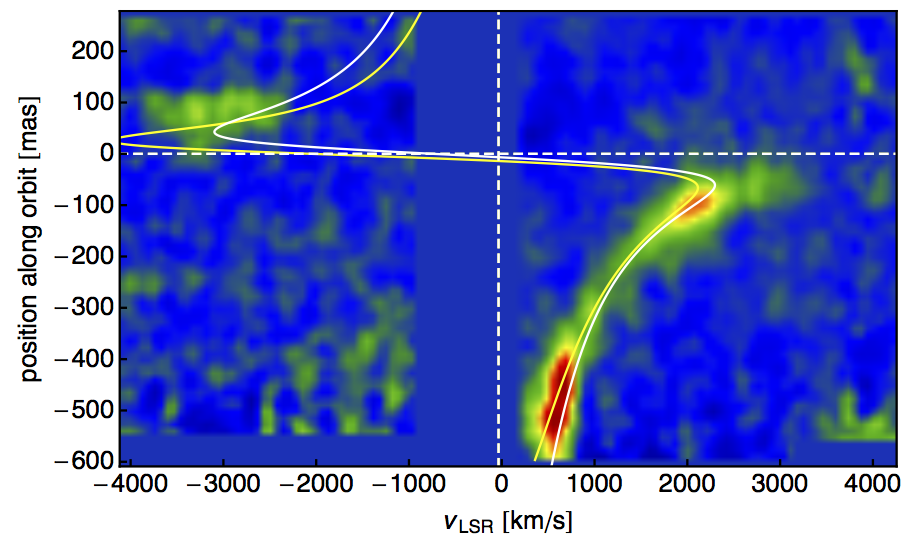
With the help of new, very sensitive SINFONI data, we are able to observe for the first time blue-shifted emission in the position-velocity diagram of the gas cloud G2. As the cloud is extremely stretched out (more than 15,000 Schwarzschild radii in the meantime), part of it seems to have passed pericenter (~2000 Schwarzschild radii) already, a process which will continue for roughly another year. The new data also enables us to update the observed kinematical and physical properties of the gas cloud, confirming the near-radial orbit of the object. Very puzzling for current models for the cloud is the constant Brackett-gamma luminosity of the head (over the past 9 years).
Gillessen, Genzel, Fritz, Eisenhauer, Pfuhl, Ott, Schartmann, Ballone, Burkert, 2013, ApJ, 774, 44
G2 - a compact mass-loosing source?
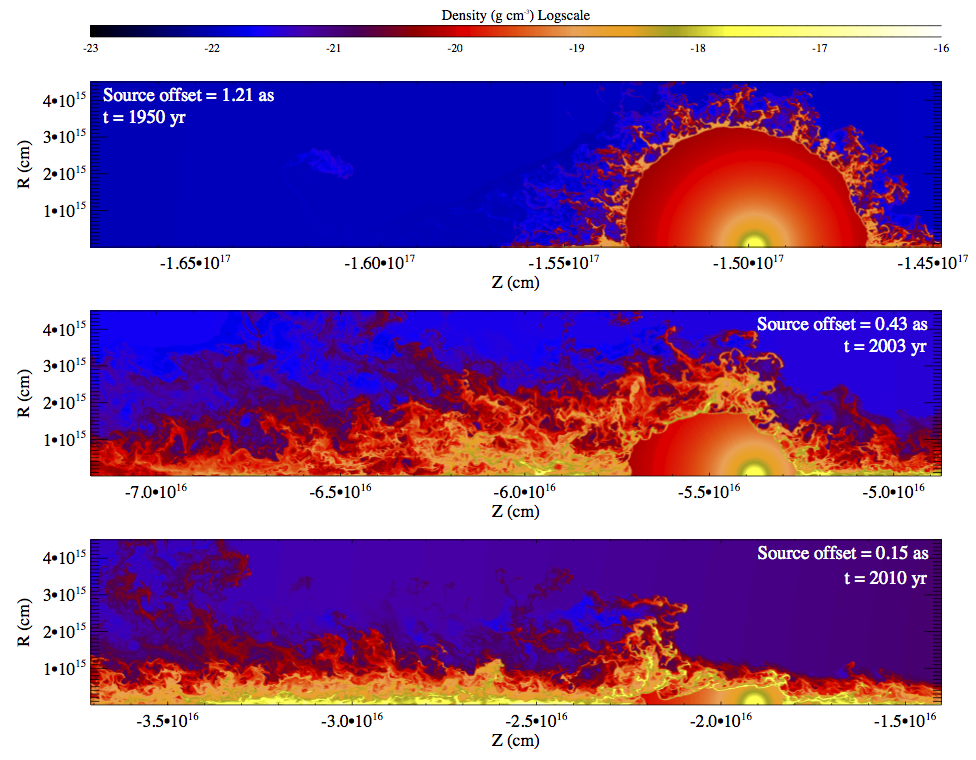
G2 might be a diffuse cloud or the result of an outflow from an invisible star embedded in it. With hydrodynamical simulations of the evolution of different spherically symmetric winds of a stellar object embedded in G2, we find that the thermal pressure of the hot and dense atmosphere confines the wind, while its ram pressure shapes it via stripping along the orbit. Tidal forces squeeze the wind near pericenter, reducing it to a thin and elongated filament. Most of the Brackett-gamma luminosity comes from the dense shocked wind shells, which have a highly filamentary structure with low volume filling factor. For our assumed atmosphere, the observations can be best matched by a mass outflow rate of 8.8e-8 Msun/yr and a wind velocity of 50 km/s, being compatible with a young TTauri star wind.
Ballone, Schartmann, Burkert, Gillessen, Genzel, Fritz, Eisenhauer, Pfuhl, Ott, 2013, 776, 13
Formation of counter-rotating stellar discs in the GC
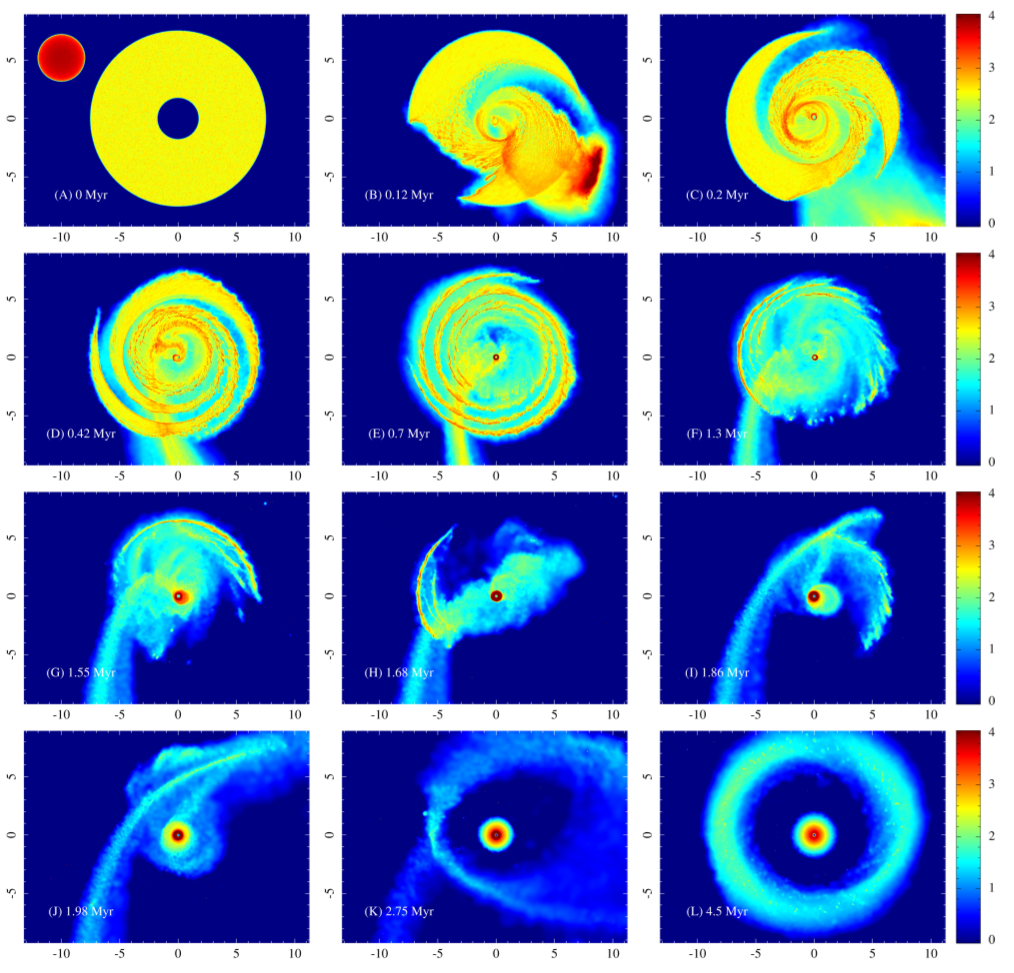
The origin of the two young, counter-rotating, sub-parsec scale stellar discs around the supermassive black hole SgrA* at the Galactic Centre is still puzzling. In our model, the collision of a single molecular cloud with a circum-nuclear gas disc (similar to the one observed presently) leads to multiple streams of gas flowing towards the black hole and creating accretion discs with angular momentum depending on the ratio of cloud and circum-nuclear disc material. The infalling gas creates two inclined, counter-rotating sub-parsec scale accretion discs around the supermassive black hole with the first disc forming roughly 1 Myr earlier, allowing it to fragment into stars and get dispersed before the second, counter-rotating disc forms. Our Gadget simulations predict that the collision event generates spiral-like filaments of gas, feeding the Galactic Center prior to disc formation with a geometry and inflow pattern that is in agreement with the structure of the so called mini-spiral that has been detected in the Galactic Center.
Alig, Schartmann, Burkert, Dolag, 2013, 771, 119
Dynamics of gas and dust clouds in Active Galactic Nuclei
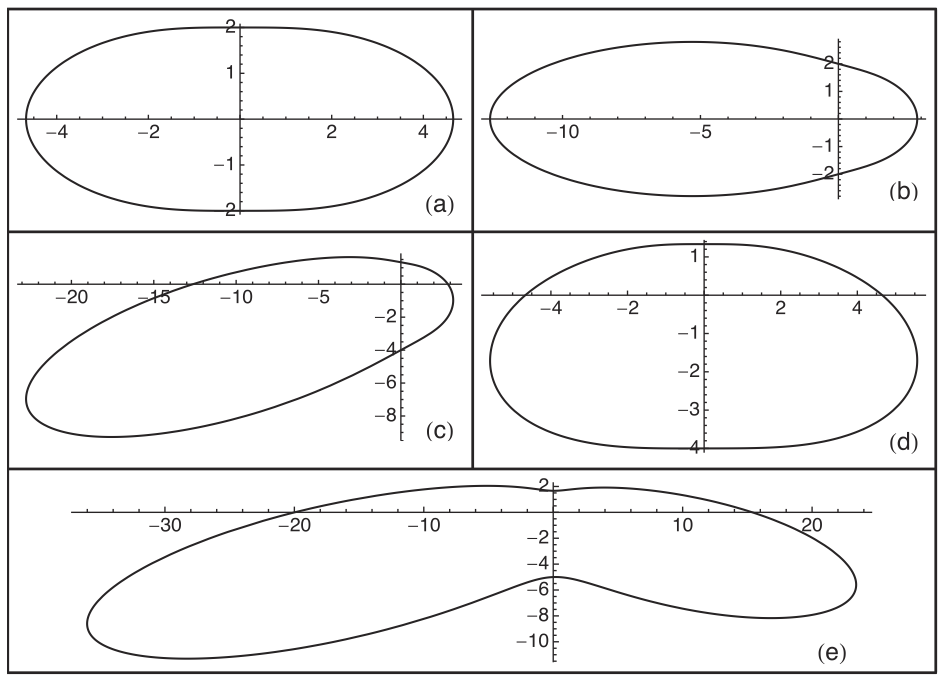
We analyse the motion of single optically thick clouds in the potential of a central mass under the influence of an anisotropic radiation field, a model applicable to the inner region of active galactic nuclei. Resulting orbits are analytically soluble for constant cloud column densities. All stable orbits are closed, although they have non-trivial shapes. Furthermore, there exists a stability criterion in the form of a critical inclination, which depends on the luminosity of the central source and the column density of the cloud.
Plewa, Schartmann & Burkert, 2013, MNRAS, 431, 127
Observations of the Gas Cloud G2 in the Galactic Center
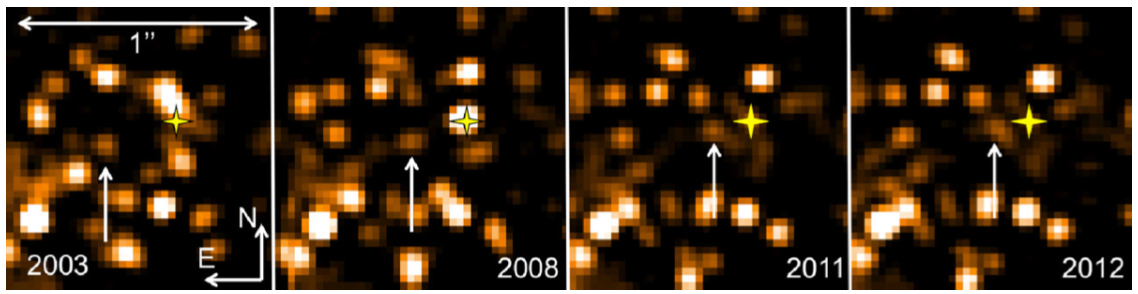
New observations of the recently discovered gas cloud G2 (Gillessen et al., 2012) currently falling toward the massive black hole in the Galactic Center are presented. The new data confirm that G2 is on a highly elliptical orbit with a predicted pericenter passage mid-2013. The updated orbit has an even larger eccentricity of 0.966 and smaller pericenter distance (2200 Schwarzschild radii). The velocity gradient of G2 has developed further to 600 km/s FWHM in summer 2012, emphasizing the currently ongoing tidal disruption of the cloud. We also detect the tail of similar total flux and on the same orbit as G2 along the trajectory. The Brackett gamma flux of G2 has not changed by more than 10% between 2008 and 2012.
Gillessen, Genzel, Fritz, Eisenhauer, Pfuhl, Ott, Cuadra, Schartmann, Burkert, 2013, ApJ, 763, 78
Magnetohydrodynamic stability of broad line region clouds
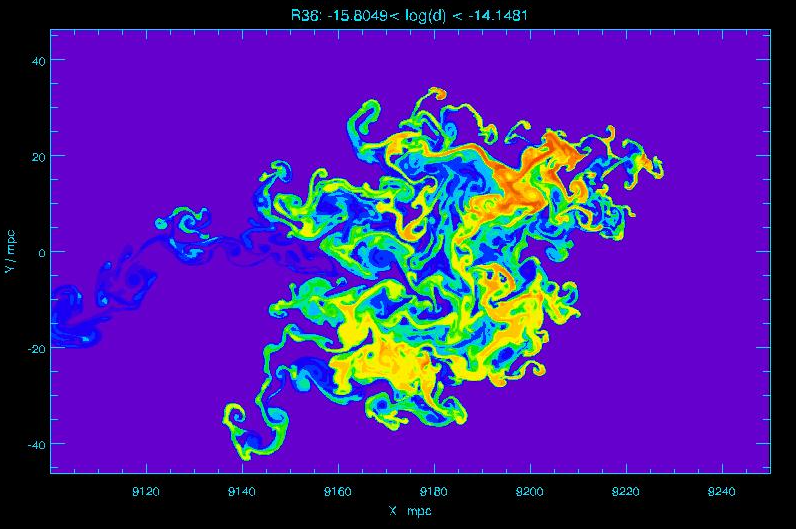
We investigate the effect of several magnetic field configurations on BLR cloud stability in 2D axisymmetric magnetohydrodynamic simulations. For a purely azimuthal magnetic field which provides the dominant pressure support, the cloud first gets compressed by the opposing radiative and gravitational forces, leading to an increase of the pressure inside the cloud and vertical expansion. Kelvin-Helmholtz and column density instabilities result in a filamentary fragmentation of the cloud. This radiative dispersion continues until the cloud is shredded down to the resolution level. For a helical magnetic field configuration, a much more stable cloud core survives with a stationary density histogram which takes the form of a power law.
Krause, Schartmann, Burkert, 2013, MNRAS, 425, 3172
Simulations of the origin and fate of the GC cloud G2

Our hydrodynamical investigations of the origin and fate of the recently discovered gas cloud G2 with the PLUTO code in combination with currently available observations favor two scenarios: a Compact Cloud which started around the year 1995 and a Spherical Shell of gas, with an apocenter distance within the disc(s) of young stars and a radius of a few times the size of the Compact Cloud. The latter can account for both G2's signal as well as the fainter extended tail-like structure G2t seen at larger distances from the black hole and smaller velocities. From these first idealized simulations, we expect a roughly constant feeding of the supermassive black hole through a nozzle-like structure over a long period, starting shortly after the closest approach in 2013.51 for the Compact Cloud, which might lead to a boost of the luminosity of Sgr A* in several wavelength bands. We also find that the near-future evolution of the cloud will be a sensitive probe of the conditions of the gas distribution in the milli-parsec environment of the massive black hole in the Galactic center (image credit: ESO/MPE/Marc Schartmann).
Schartmann, Burkert, Alig, Gillessen, Genzel, Eisenhauer, Fritz, 2012, ApJ, 755, 155
The complexity of parsec-scaled dusty tori in AGN
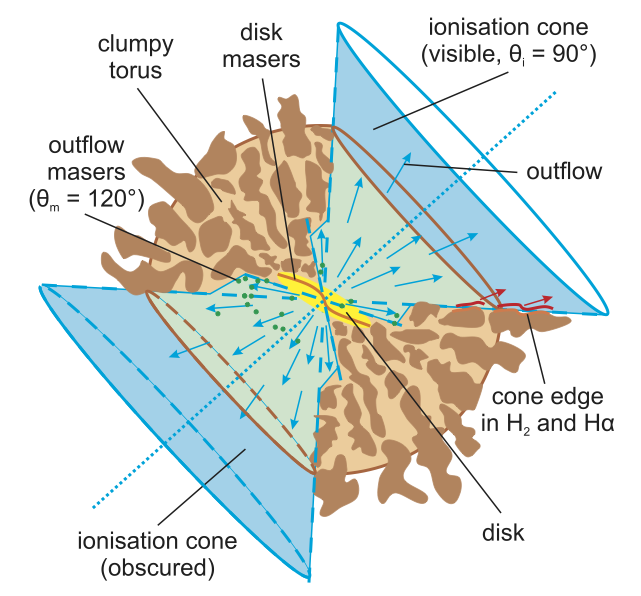
The warm gas and dust in AGN tori provides the material for accretion onto the super-massive black hole and is held responsible for the orientation-dependent obscuration of the central engine. The AGN-heated dust distributions turn out to be very compact with sizes on scales of about a parsec in the mid-infrared. Only infrared interferometry currently provides the necessary angular resolution to directly study the physical properties of this dust. Size estimates for the dust distributions derived from interferometric observations can be used to construct a size-luminosity relation for the dust distributions. The large scatter about this relation suggests significant differences between the dust tori in the individual galaxies, even for nuclei of the same class of objects and with similar luminosities. This questions the simple picture of the same dusty doughnut in all AGN. An extensive new interferometric data set was obtained for the Circinus galaxy - the closest Seyfert 2 galaxy. It shows that the dust emission comes from a very dense, disc-like structure which is surrounded by a geometrically thick, similarly warm dust distribution as well as significant amounts of warm dust within the ionisation cone.
Tristram, Schartmann, Burtscher, Meisenheimer, Jaffe, Kishimoto, Hönig, Weigelt, 2012, JPhCS, 372, 2035
Physics of the Galactic Center Cloud G2
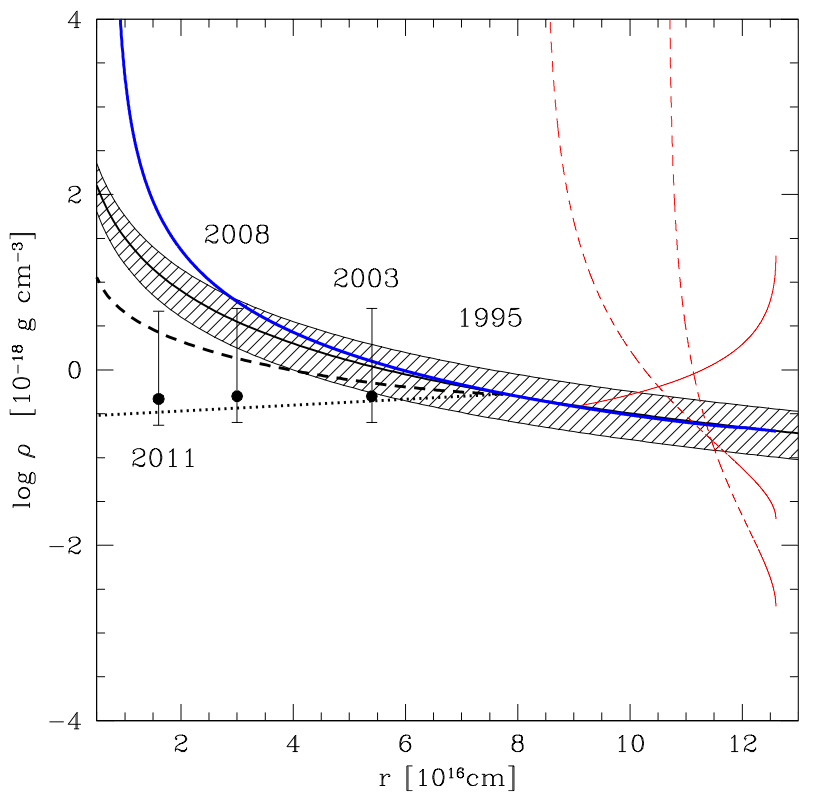
We investigate the origin, structure, and evolution of the small gas cloud G2, which is on an orbit almost straight into the Galactic central supermassive black hole (SMBH). G2 is a sensitive probe of the hot accretion zone of Sgr A*. Its mass is equal to the critical mass below which cold clumps would be destroyed quickly by evaporation. Its mass is also constrained by the fact that at apocenter its sound crossing timescale was equal to its infall timescale. If the cloud had formed at apocenter in the "clockwise" stellar disc as expected from its orbit, it would be torn into a very elongated spaghetti-like filament by 2011, which is not observed, but an in-situ formation model in 1995 is consistent with the data. This problem can be solved if G2 is the head of a larger, shell-like structure that formed at apocenter. Our numerical simulations show that this scenario explains not only G2's observed kinematical and geometrical properties but also the Brackett-gamma observations of a low surface brightness gas tail that trails the cloud.
Burkert, Schartmann, Alig, Gillessen, Genzel, Fritz, Eisenhauer, 2012, ApJ, 750, 58
Secular evolution in the black hole growth of NLS1 galaxies
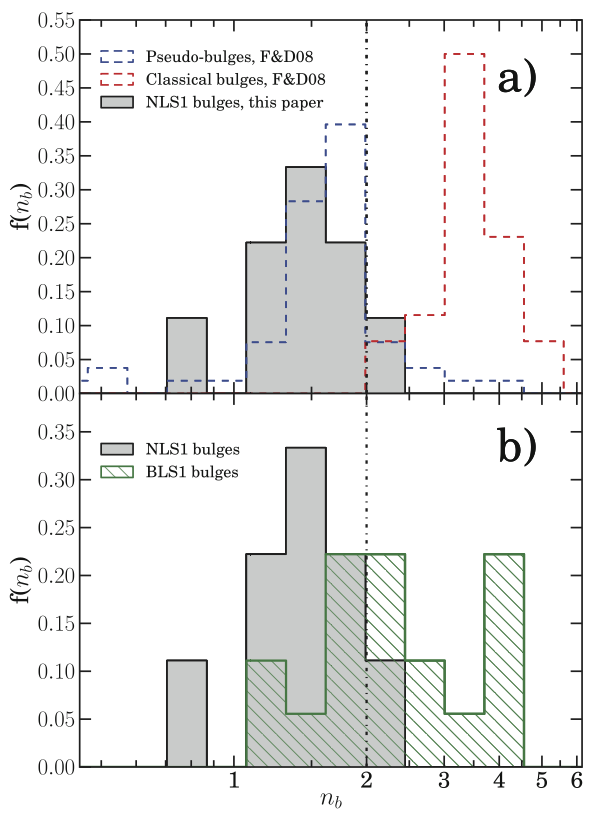
Narrow-line Seyfert 1 (NLS1) galaxies show extreme properties with respect to the other Seyfert galaxies. Indeed, they are thought to be accreting at Eddington rates and to possess low-mass black holes. Therefore, they may represent a key class of objects for understanding the co-evolution of black holes and their host galaxies. In order to explain the unusual properties of NLS1 (Narrow Line Seyfert 1) galaxies, we propose that NLS1s represent a class of active galactic nucleus in which the black hole growth is, and has always been, dominated by secular evolution. First, we show that the evolution of NLS1s is presently driven by secular processes. Secondly, we demonstrate that NLS1 host bulges are pseudo-bulges and are statistically different from BLS1 bulges. This difference points to the particular importance of secular processes in the past evolution of their hosts. We show that NLS1s are not necessarily in a special phase of black hole growth and that several Gyr are required for their black hole masses to become similar to BLS1s.
Orban de Xivry, Davies, Schartmann, Komossa, Marconi, Hicks, Engel, Tacconi, 2011, MNRAS, 417, 2721
Radiation feedback on dusty clouds during Seyfert activity
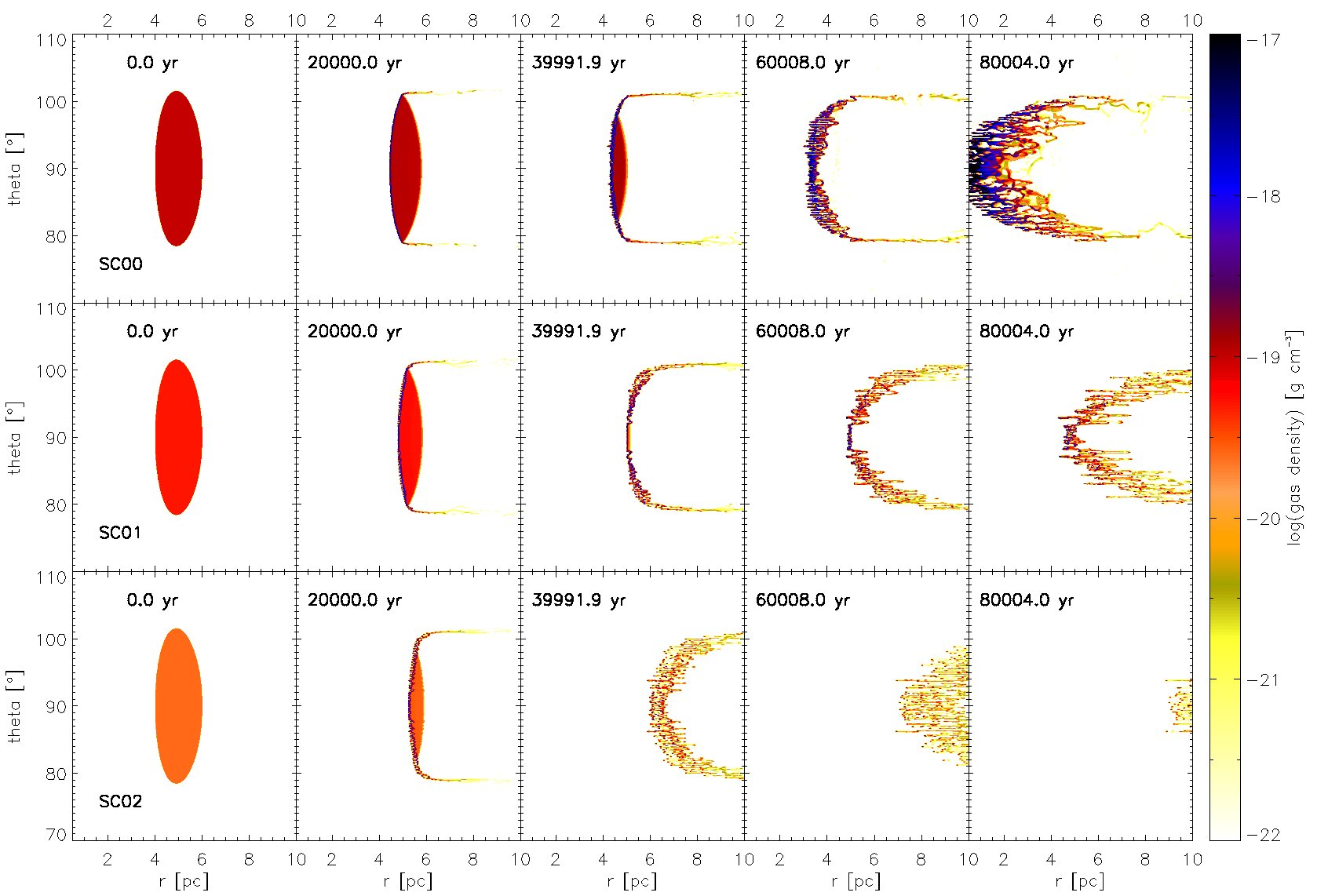
We investigate the evolution of dusty gas clouds falling into the centre of an active Seyfert nucleus using 2D high-resolution radiation hydrodynamics simulations. We find three distinct phases of the evolution of the cloud: (i) formation of a lenticular shape with dense inner rim caused by the interaction of gravity and radiation pressure (the lense phase); (ii) formation of a clumpy sickle-shaped structure as the result of a converging flow (the clumpy sickle phase) and (iii) a filamentary phase caused by a rapidly varying optical depth along the sickle. Depending on the column density of the cloud, it will either be pushed outwards or its central (highest column density) parts move inwards, while there is always some material pushed outwards by radiation pressure effects.
Schartmann, Krause, Burkert, 2011, MNRAS, 415, 741
The size-luminosity relation of AGN dust tori in the MIR
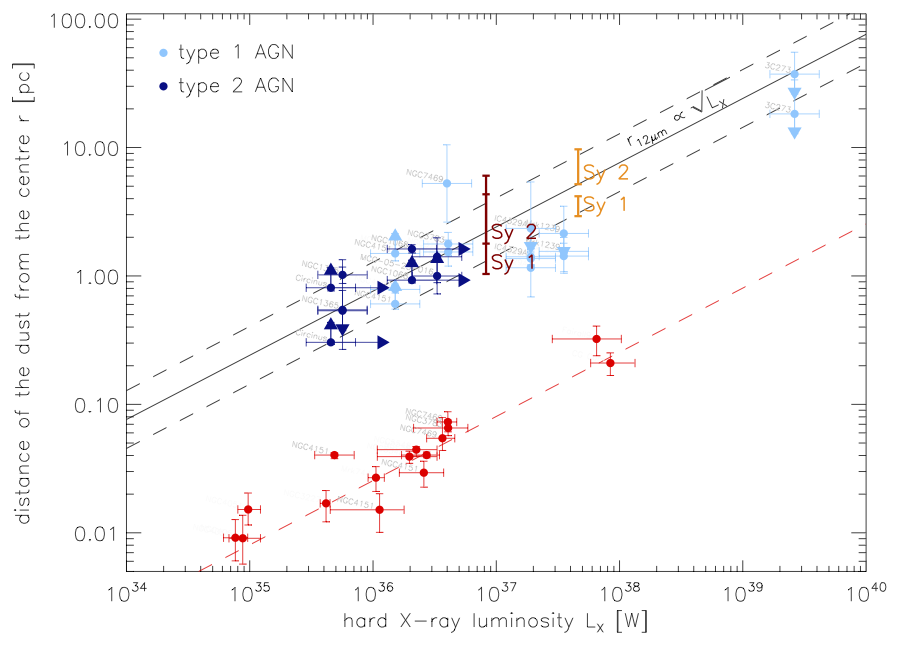
We carry out a detailed analysis of the size-luminosity relation of AGN tori in the MIR to investigate which of the general properties of the dusty tori in AGN can be derived from this relation by comparing the measured sizes to those derived from hydrodynamical and radiative transfer models of AGN tori. The size estimates derived from the models are consistent with the observed ones, but the models predict a significant offset between the sizes derived for face-on (Seyfert 1 case) and edge-on (Seyfert 2 case) tori: the face-on tori should appear significantly more compact for the same luminosity. This offset is not observed in the current data, probably because of the large uncertainties and low statistics of the present interferometric measurements. Furthermore, we find a ratio of the mid- to near-infrared sizes of approximately 30, whereas the first probes the body of the torus and the second is an estimate of the inner rim.
Tristram, Schartmann, 2011, A&A, 531, 99
Stellar discs formed by SMBH-cloud collisions in the GC
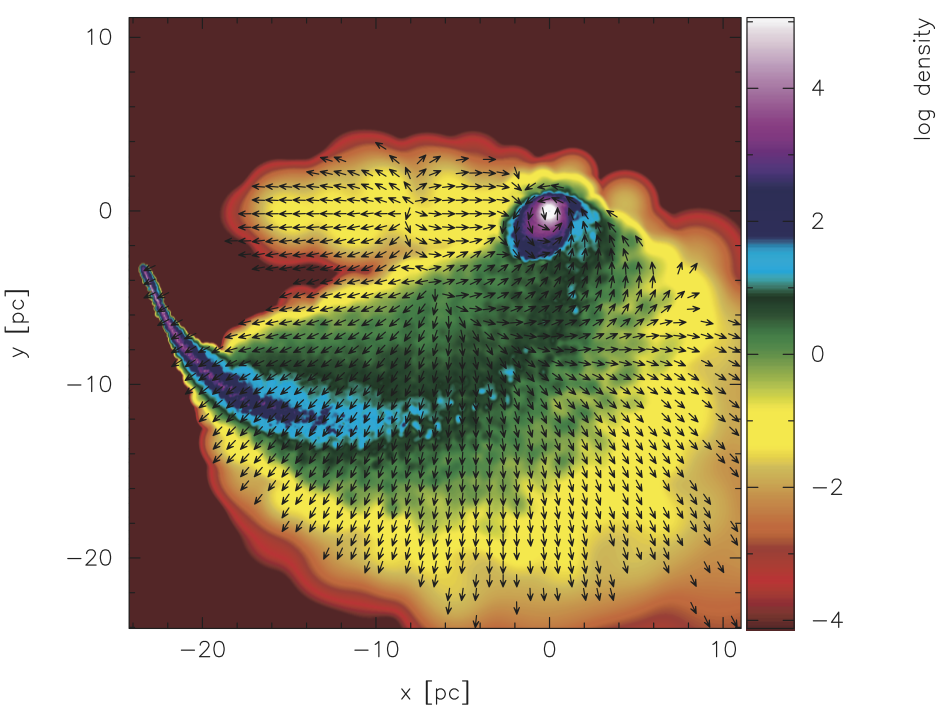
We perform Gadget simulations of clouds in the Galactic Centre (GC) engulfing the nuclear supermassive black hole and show that this mechanism naturally leads to the formation of gaseous accretion discs with properties similar to the expected gaseous progenitor discs that fragmented into the observed stellar disc in the GC. Colliding gas streams efficiently redistribute angular momentum, resulting in a compact gaseous accretion disc. A comparison of simulations with different equations of state (adiabatic, isothermal and full cooling) demonstrates the importance of including a detailed thermodynamical description. However the simple isothermal approach already yields good results on the radial mass transfer and accretion rates, as well as disc eccentricities and sizes. We find that the cloud impact parameter strongly influences the accretion rate, whereas the impact velocity has a small effect on the accretion rate.
Alig, Burkert, Johansson, Schartmann, 2011, MNRAS, 412, 469
Stability of BLR cloud orbits
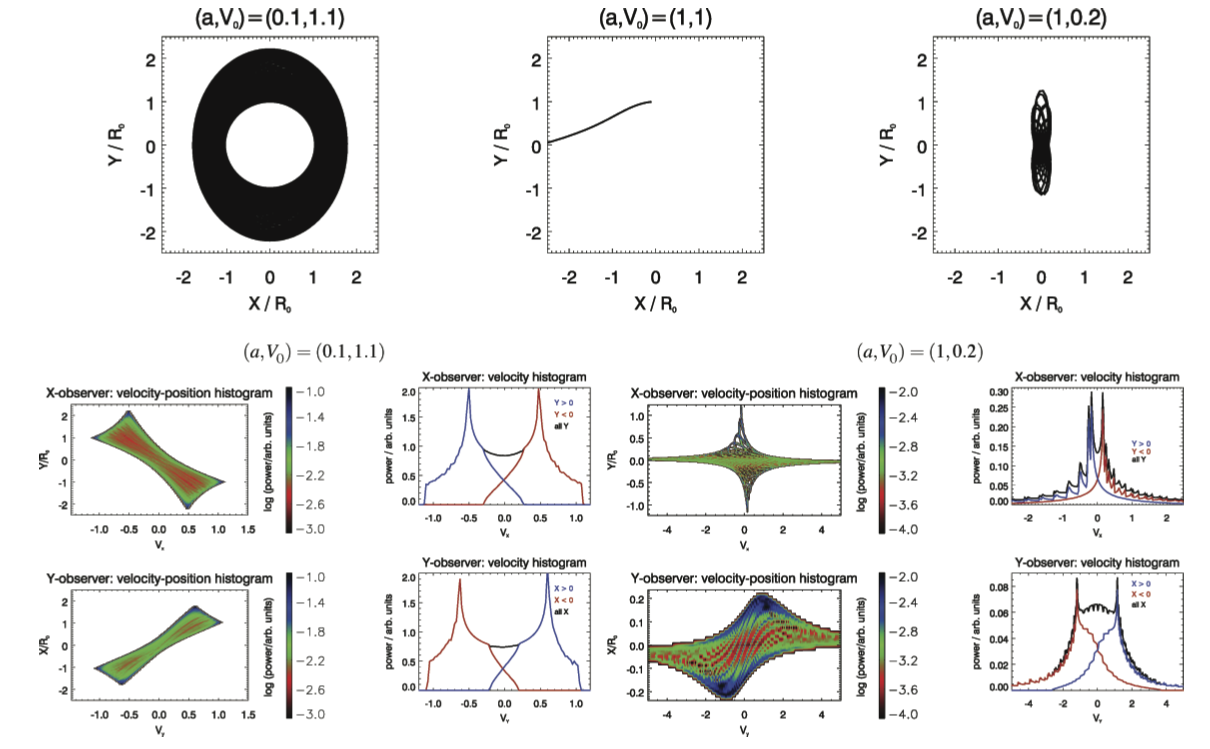
We investigate the global dynamic stability of spherical clouds in the broad-line region (BLR) of active galactic nuclei (AGN), exposed to radial radiation pressure, gravity of the central black hole (BH) and centrifugal forces assuming the clouds adapt their size according to the local pressure. We consider both isotropic and anisotropic light sources. In both cases, stable orbits exist also for very sub-Keplerian rotation for which the radiation pressure contributes substantially to the force budget. This gives further support for the model of Marconi et al., who pointed out that BH masses might be significantly underestimated if radiation pressure is neglected. For anisotropic illumination, energy is conserved for averages over long time intervals only, but not for individual orbits, leading to Rosetta orbits. Initially isotropic relatively low column density systems would therefore turn into a disc when an anisotropic AGN is switched on.
Krause, Burkert, Schartmann, 2011, MNRAS, 411, 550
Modelling shear flows with SPH and grid-based methods
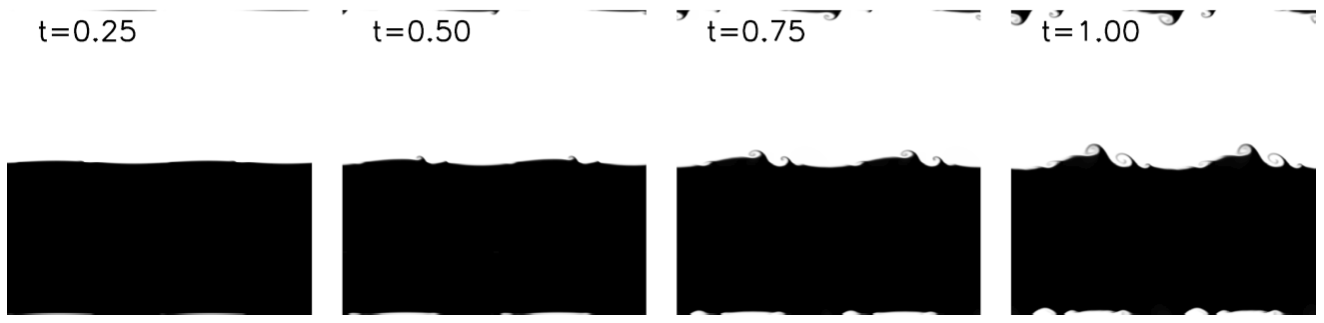
We study the evolution of the Kelvin-Helmholtz instability (KHI) analytically and numerically for SPH and grid-based codes. We derive the dispersion relation for the two-dimensional KHI including viscous dissipation, used to estimate the intrinsic viscosity of various numerical schemes. We explicitly demonstrate the effect of dissipation-inhibiting mechanisms such as the Balsara viscosity on the evolution of the KHI. With standard SPH, increasing density contrasts lead to a continuously increasing suppression of the KHI (with complete suppression from a contrast of 6:1 or higher). Alternative SPH formulation including an artificial thermal conductivity reproduces the analytically expected growth rates up to a density contrast of 10:1. The investigated grid codes result in a consistent non-viscous evolution in agreement with the analytical prediction.
Junk, Walch, Heitsch, Burkert, Wetzstein, Schartmann, Price, 2010, MNRAS, 407, 1933
The nuclear disc in the Seyfert 2 galaxy NGC 1068
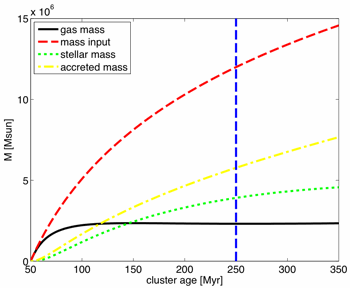
We employ 3D hydrodynamical simulations with the PLUTO code. The physical scenario is the same as described below, but here we concentrate solely on the turbulent mass input from the evolving nuclear star cluster, ameliorated several routines and adapted the parameters to NGC 1068. In order to capture the relevant physics in the inner disc, which builts up, we use the mass flowing into the central region and feed it into 1D effective disc simulations, where we take viscous evolution and star formation into account. We find that the disc properties like size, mass and accretion towards the centre are in good agreement with observations. This shows that stellar evolution in nuclear star clusters is an important mechanism for obscuring and feeding black holes and triggering activity cycles.
Schartmann, Burkert, Krause, Camenzind, Meisenheimer, Davies, 2010, MNRAS, 403, 1801
Hydrodynamic models of AGN tori
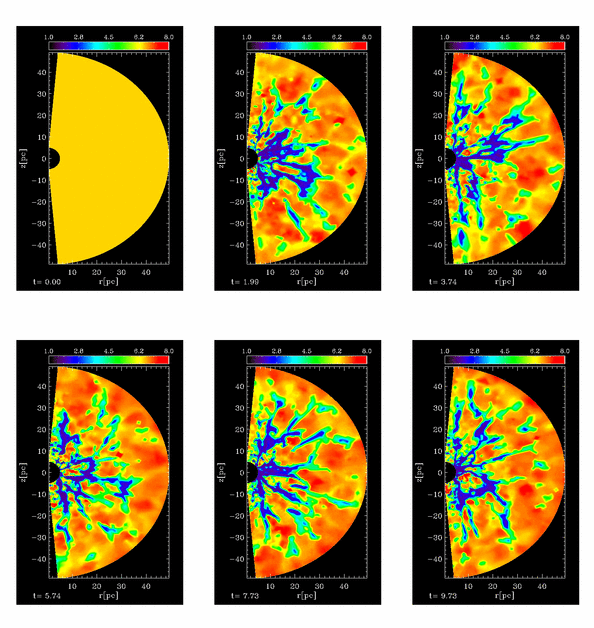
With the help of hydrodynamical simulations, we investigate the effect of stellar feedback from a young nuclear star cluster on the interstellar medium in centres of AGN as a putative mechanism to build up AGN tori. We follow the evolution of the interstellar medium by taking discrete mass-loss and energy ejection due to stellar processes, as well as optically thin radiative cooling into account. In a post-processing step, we calculate observable quantities like spectral energy distributions (SEDs) and surface brightness distributions with the help of the radiative transfer code MC3D. The interplay between injection of mass, supernova explosions and radiative cooling leads to a two-component structure made up of a cold geometrically thin, but optically thick and very turbulent disc residing in the vicinity of the angular momentum barrier, surrounded by a filamentary structure. The latter consists of cold long radial filaments flowing towards the disc and a hot tenuous medium in between, which shows both inwards and outwards directed motions. With the help of this modelling, we are able to reproduce the range of observed neutral hydrogen column densities of a sample of Seyfert galaxies as well as the relation between them and the strength of the silicate 10 micron spectral feature. Despite being quite crude, our mean Seyfert galaxy model is even able to describe the SEDs of two intermediate type Seyfert galaxies observed with the Spitzer Space Telescope.
Schartmann, Meisenheimer, Klahr, Camenzind, Wolf, Henning, 2009, MNRAS, 393, 759
3D Clumpy Torus models
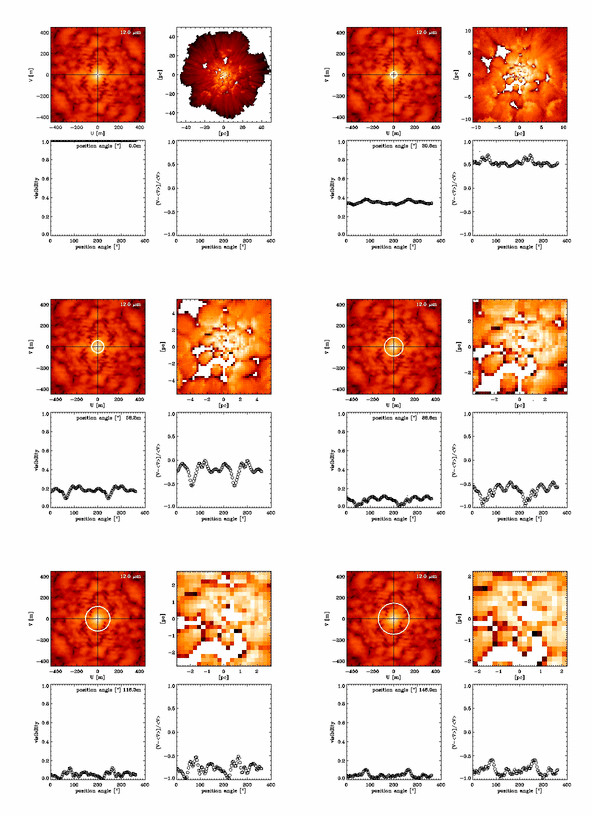
New radiative transfer calculations of a three-dimensional clumpy model of AGN dust tori are performed and directly compared to a corresponding continuous model concerning the temperature distributions, the surface brightness distributions and interferometric visibilities, as well as spectral energy distributions. We find that the radial temperature distributions of clumpy models possess significantly enhanced scatter compared to the continuous cases. Even at large distances, clouds can be heated directly by the central accretion disc. The existence of the silicate 10 micron-feature in absorption or in emission depends sensitively on the distribution, the size and optical depth of clouds in the innermost part of the dust distribution. The main reason for this outcome are shadowing effects of clouds within the central region. After adapting the parameters of our clumpy standard model to the circumstances of the Seyfert 2 Circinus galaxy, it can simultaneously explain recent mid-infrared interferometric observations performed with MIDI, as well as high resolution spectral data.
Schartmann, Meisenheimer, Camenzind, Wolf, Tristram, Henning, 2008, A&A, 482, 67
Resolving the dust torus in the Circinus galaxy
We study the extent and morphology of the nuclear dust distribution in the Circinus galaxy using high resolution interferometric observations in the mid-infrared (with the MIDI instrument at VLTI), for which we obtained 21 visibility points. We find that the dust distribution in the nucleus of Circinus can be explained by two components, a dense and warm disc-like component of 0.4 pc size and a slightly cooler, geometrically thick torus component with a size of 2.0 pc. The disc component is oriented perpendicular to the ionisation cone and outflow and seems to show the silicate feature at 10 micron in emission. It coincides with a nuclear maser disc in orientation and size. We find that the interferometric data are inconsistent with a simple, smooth and axisymmetric dust emission, but provide strong evidence for a clumpy or filamentary dust structure. Based on a great leap forward in the quality and quantity of interferometric data, our findings confirm the presence of a geometrically thick, torus-like dust distribution in the nucleus of Circinus, as required in unified schemes of Seyfert galaxies.
Tristram, Meisenheimer, Jaffe, Schartmann, Rix, Leinert, Morel, Wittkowski, Röttgering, Perrin, Lopez, Raban, Cotton, Graser, Paresce, Henning, 2007, A&A, 474, 837
The carbon star IRC+10216
linking the complex inner region with its spherical large-scale structures
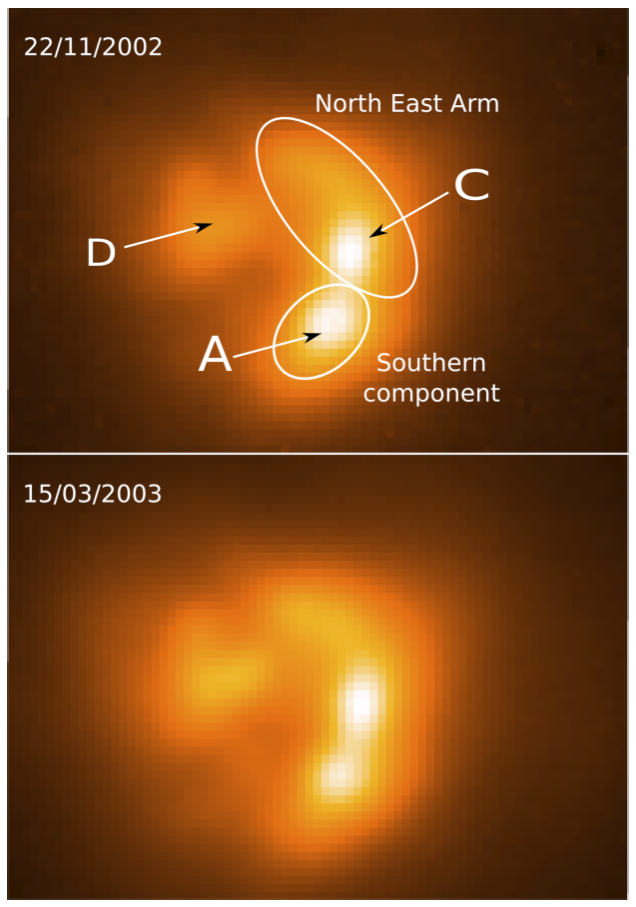
IRC+10216 is located at the tip of the asymptotic giant branch of the Hertzsprung-Russell diagram in a transition phase toward the post-asymptotic giant branch stage. Its study contributes to our knowledge of the late stage of stellar evolution of low- and intermediate-mass stars, when the circumstellar matter begins to adopt the asymmetric or bipolar forms commonly found in planetary nebulae. Using the NAOS-CONICA (NACO) adaptive optics system, we have mapped the circumstellar environment of IRC+1O216 at several wavelengths and three different epochs. The NACO study provides high-resolution and high-dynamic-range information on the different features displayed by the circumstellar envelope: clumpiness and a peanut- or bipolar-like shape at small scales. The link between the inner regions and the spherical-like shells observed at large scales is displayed in these high-dynamic-range data.
Menut, Gendron, Schartmann, Tuthill, Lopez, Danchi, Wolf, Lagrange, Flament, Rouan, Clénet, Berruyer, 2007, MNRAS, 376, L6
Radiative Transfer modelling of AGN tori

We explore physically self-consistent models of dusty molecular tori in Active Galactic Nuclei (AGN) with the goal of interpreting VLT(I) observations in great detail by means of the Monte Carlo radiative transfer code MC3D. We find that in homogeneous dust distributions the observed mid-infrared emission is dominated by the inner funnel of the torus, even when observing along the equatorial plane. Therefore, the stratification of the distribution of dust grains - both in terms of size and composition - cannot be neglected and significantly alters the SED in comparison to models that assume an average dust grain property with a common sublimation radius. The latter also suppresses the silicate emission feature at 9.7 micron. With these simulations, we are able to fit the mean SED of both type I and type II AGN very well.
Schartmann, Meisenheimer, Camenzind, Wolf, Henning, 2005, A&A, 437, 861
More images and movies of our simulational work can be found on my online material page.