- GCN NOTICE
TITLE:           GCN/FERMI NOTICE
NOTICE_DATE:     Thu 17 Jul 25 13:44:52 UT
NOTICE_TYPE:     Fermi-GBM Flight Position
RECORD_NUM:      50
TRIGGER_NUM:     774452667
GRB_RA:           45.150d {+03h 00m 36s} (J2000),
                  45.501d {+03h 02m 00s} (current),
                  44.463d {+02h 57m 51s} (1950)
GRB_DEC:         +13.400d {+13d 24' 00"} (J2000),
                 +13.500d {+13d 29' 60"} (current),
                 +13.202d {+13d 12' 09"} (1950)
GRB_ERROR:       7.82 [deg radius, statistical plus systematic]
GRB_INTEN:       312 [cnts/sec]
DATA_SIGNIF:     15.40 [sigma]
INTEG_TIME:      1.024 [sec]
GRB_DATE:        20873 TJD;   198 DOY;   25/07/17
GRB_TIME:        49462.95 SOD {13:44:22.95} UT
GRB_PHI:          83.00 [deg]
GRB_THETA:        65.00 [deg]
DATA_TIME_SCALE: 1.0240 [sec]
HARD_RATIO:      0.92
LOC_ALGORITHM:   3 (version number of)
MOST_LIKELY:      94%  GRB
2nd_MOST_LIKELY:   3%  GRO_J0422_32
DETECTORS:       0,1,0, 0,0,0, 0,0,0, 0,1,0, 0,0,
SUN_POSTN:       117.19d {+07h 48m 46s}  +21.08d {+21d 05' 05"}
SUN_DIST:         68.34 [deg]   Sun_angle= 4.8 [hr] (West of Sun)
MOON_POSTN:       16.77d {+01h 07m 05s}   +9.91d {+09d 54' 31"}
MOON_DIST:        28.34 [deg]
MOON_ILLUM:      55 [%]
GAL_COORDS:      164.73,-38.77 [deg] galactic lon,lat of the burst (or transient)
ECL_COORDS:       46.58, -3.54 [deg] ecliptic lon,lat of the burst (or transient)
LC_URL:          http://heasarc.gsfc.nasa.gov/FTP/fermi/data/gbm/triggers/2025/bn250717572/quicklook/glg_lc_medres34_bn250717572.gif
COMMENTS:        Fermi-GBM Flight-calculated Coordinates.
COMMENTS:        This trigger occurred at longitude,latitude = 320.37,25.30 [deg].
COMMENTS:        The LC_URL file will not be created until ~15 min after the trigger.
- GCN NOTICE
TITLE:           GCN/FERMI NOTICE
NOTICE_DATE:     Thu 17 Jul 25 13:45:11 UT
NOTICE_TYPE:     Fermi-GBM Ground Position
RECORD_NUM:      60
TRIGGER_NUM:     774452667
GRB_RA:           44.070d {+02h 56m 17s} (J2000),
                  44.431d {+02h 57m 43s} (current),
                  43.365d {+02h 53m 27s} (1950)
GRB_DEC:         +18.750d {+18d 45' 00"} (J2000),
                 +18.852d {+18d 51' 07"} (current),
                 +18.549d {+18d 32' 56"} (1950)
GRB_ERROR:       4.03 [deg radius, statistical only]
DATA_SIGNIF:     16.90 [sigma]
DATA_INTERVAL:   1.024 [sec]
GRB_DATE:        20873 TJD;   198 DOY;   25/07/17
GRB_TIME:        49462.95 SOD {13:44:22.95} UT
GRB_PHI:          79.00 [deg]
GRB_THETA:        69.00 [deg]
E_RANGE:         44.032 - 279.965 [keV]
LOC_ALGORITHM:   4173 (Gnd S/W Version number)
SUN_POSTN:       117.19d {+07h 48m 46s}  +21.08d {+21d 05' 05"}
SUN_DIST:         67.79 [deg]   Sun_angle= 4.9 [hr] (West of Sun)
MOON_POSTN:       16.78d {+01h 07m 06s}   +9.91d {+09d 54' 36"}
MOON_DIST:        28.20 [deg]
MOON_ILLUM:      55 [%]
GAL_COORDS:      159.75,-35.04 [deg] galactic lon,lat of the burst (or transient)
ECL_COORDS:       47.10,  1.89 [deg] ecliptic lon,lat of the burst (or transient)
LC_URL:          http://heasarc.gsfc.nasa.gov/FTP/fermi/data/gbm/triggers/2025/bn250717572/quicklook/glg_lc_medres34_bn250717572.gif
POS_MAP_URL:     http://gcn.gsfc.nasa.gov/notices_f/gbm_gnd_loc_map_774452667.fits
COMMENTS:        Fermi-GBM Ground-calculated Coordinates.
COMMENTS:        This Notice was ground-generated -- not flight-generated.
COMMENTS:        The LC_URL file will not be created/available until ~15 min after the trigger.
COMMENTS:        The POS_MAP_URL file will not be created/available until ~1.5 min after the notice.
- GCN NOTICE
TITLE:           GCN/FERMI NOTICE
NOTICE_DATE:     Thu 17 Jul 25 13:53:42 UT
NOTICE_TYPE:     Fermi-GBM Final Position
RECORD_NUM:      0
TRIGGER_NUM:     774452667
GRB_RA:           44.430d {+02h 57m 43s} (J2000),
                  44.795d {+02h 59m 11s} (current),
                  43.716d {+02h 54m 52s} (1950)
GRB_DEC:         +20.880d {+20d 52' 48"} (J2000),
                 +20.981d {+20d 58' 52"} (current),
                 +20.680d {+20d 40' 48"} (1950)
GRB_ERROR:       3.80 [deg radius, statistical only]
GRB_DATE:        20873 TJD;   198 DOY;   25/07/17
GRB_TIME:        49462.95 SOD {13:44:22.95} UT
GRB_PHI:          77.00 [deg]
GRB_THETA:        70.00 [deg]
E_RANGE:         44.032 - 279.965 [keV]
LOC_ALGORITHM:   41731 (Gnd S/W Version number)
SUN_POSTN:       117.20d {+07h 48m 47s}  +21.08d {+21d 05' 02"}
SUN_DIST:         66.91 [deg]   Sun_angle= 4.8 [hr] (West of Sun)
MOON_POSTN:       16.85d {+01h 07m 24s}   +9.95d {+09d 56' 52"}
MOON_DIST:        29.04 [deg]
MOON_ILLUM:      55 [%]
GAL_COORDS:      158.65,-33.09 [deg] galactic lon,lat of the burst (or transient)
ECL_COORDS:       48.03,  3.83 [deg] ecliptic lon,lat of the burst (or transient)
LC_URL:          http://heasarc.gsfc.nasa.gov/FTP/fermi/data/gbm/triggers/2025/bn250717572/quicklook/glg_lc_medres34_bn250717572.gif
LOC_URL:         http://heasarc.gsfc.nasa.gov/FTP/fermi/data/gbm/triggers/2025/bn250717572/quicklook/glg_locplot_all_bn250717572.png
COMMENTS:        Fermi-GBM Final Position.
COMMENTS:        This Notice was ground-generated -- not flight-generated.
COMMENTS:        The LC_URL file should be available by the time this FINAL notice is produced.
COMMENTS:        This notice was generated completely by automated pipeline processing.
COMMENTS:        This is likely a Long GRB.
- GCN Circular #41107
The Fermi GBM team reports the detection of a likely LONG GRB
At 13:44:22 UT on 17 Jul 2025, the Fermi Gamma-ray Burst Monitor (GBM) triggered and located GRB 250717B (trigger 774452667.945704 / 250717572).
The on-ground calculated location, using the Fermi GBM trigger data, is RA = 44.4, Dec = 20.9 (J2000 degrees, equivalent to J2000 02h 57m, 20d 53'), with a statistical uncertainty of 3.8 degrees.
The angle from the Fermi LAT boresight is 70.0 degrees.
The skymap can be found here:
https://heasarc.gsfc.nasa.gov/FTP/fermi/data/gbm/triggers/2025/bn250717572/quicklook/glg_skymap_all_bn250717572.png
The HEALPix FITS file, including the estimated localization systematic, can be found here:
https://heasarc.gsfc.nasa.gov/FTP/fermi/data/gbm/triggers/2025/bn250717572/quicklook/glg_healpix_all_bn250717572.fit
The GBM light curve can be found here:
https://heasarc.gsfc.nasa.gov/FTP/fermi/data/gbm/triggers/2025/bn250717572/quicklook/glg_lc_medres34_bn250717572.gif

- GCN Circular #41110
Samuele Ronchini (PSU), James DeLaunay (PSU), Aaron Tohuvavohu (Caltech), Jamie A. Kennea (PSU), Tyler Parsotan (NASA GSFC), Maia Williams (PSU) report:
Swift/BAT did not localize GRB 250717B onboard (T0: 2025-07-17T13:44:22 UTC, Fermi GCN 41107).
The Fermi notice, distributed in near real-time, triggered the Swift Mission Operations Center operated Gamma-ray Urgent Archiver for Novel Opportunities (GUANO; Tohuvavohu et al. 2020, ApJ, 900, 1).
Upon trigger by this notice, GUANO sent a command to the Swift Burst Alert Telescope (BAT) to save 200 seconds of BAT event-mode data from [-50,+150] seconds around the time of the burst. All the requested event mode data was delivered to the ground.
The position is found with the newly developed pipeline BAT-GLIMPSE: Gamma-ray Localization using Imaging and Mosaic techniques for Pointing and Slew Epochs (Ronchini et. al, in prep). The pipeline makes use of the tools from BatAnalysis ([Parsotan et al. 2025](https://iopscience.iop.org/article/10.3847/1538-4357/ade240)). The source is found with an SNR = 26.3.
The BAT position is:
RA, Dec = 44.1179, 26.3789 deg which is
RA(J2000) = 02h 56m 28.30s
Dec(J2000) = 26d 22’ 44.0″
with an estimated uncertainty of 3 arcmin radius.
More details about this burst can be found on the trigger report page here: https://guano.swift.psu.edu/trigger_report?id=774452698
XRT and UVOT follow-up has been requested. Results of follow-up observations will be reported in future circulars.
GUANO is a fully autonomous, extremely low latency, spacecraft commanding pipeline designed for targeted recovery of BAT event mode data around the times of compelling astrophysical events to enable more sensitive GRB searches.
A live reporting of Swift/BAT event data recovered by GUANO can be found at: https://www.swift.psu.edu/guano/
- GCN Circular #41111
Jacob Smith (UAH) and C. Meegan (UAH) report on behalf of
the Fermi Gamma-ray Burst Monitor Team:
"At 13:44:22.95 UT on 17 July 2025, the Fermi Gamma-ray Burst Monitor (GBM)
triggered and located GRB 250717B (trigger 774452667/250717572).
which was also detected by Swift/BAT-GUANO (Samuele Ronchini et al. 2025, GCN 41110).
The Fermi GBM on-ground location is consistent with the Swift/BAT-GUANO position.
The angle from the Fermi LAT boresight is 74 degrees.
The GBM light curve consists of a single emission episode with a duration (T90)
of about 6.4 s (50-300 keV). The time-averaged spectrum
from T0+0.002 to T0+7.360 s is best fit by
a power law function with an exponential high-energy cutoff.
The power law index is -0.9 +/- 0.1 and the cutoff energy,
parameterized as Epeak, is 75 +/- 5 keV.
A Band function fits equally well with Epeak = 72 +/- 6 keV, alpha = -0.9 +/- 0.2 and beta = -3.2 +/- 0.9.
The event fluence (10-1000 keV) in this time interval is
(1.36 +/- 0.05)E-06 erg/cm^2. The 1-sec peak photon flux measured
starting from T0+0.13 s in the 10-1000 keV band is 6.1 +/- 0.3 ph/s/cm^2.
The spectral analysis results presented above are preliminary;
final results will be published in the GBM GRB Catalog:
https://heasarc.gsfc.nasa.gov/W3Browse/fermi/fermigbrst.html
For Fermi GBM data and info, please visit the official Fermi GBM Support Page:
https://fermi.gsfc.nasa.gov/ssc/data/access/gbm/"
- GCN Circular #41113
P. A. Evans (U. Leicester) reports on behalf of the Swift team:
Swift has initiated a ToO observation of the Fermi/GBM-detected event
GRB 250717B. Automated analysis of the XRT data will be presented online at
https://www.swift.ac.uk/ToO_GRBs/00021846
Any uncatalogued X-ray sources detected in this analysis will be
reported on this website and via GCN COUNTERPART notices. These are
not necessarily related to the Fermi/GBM event. Any X-ray source
considered to be a probable afterglow candidate will be reported via a
GCN Circular after manual consideration.
Details of the XRT automated analysis methods are detailed in Evans et
al. (2007, A&A, 469, 379; 2009, MNRAS, 397, 1177 and 2014, ApJS, 210, 8).
This circular is an official product of the Swift-XRT team.
- GCN Circular #41119
S. Dichiara (PSU), J.A. Kennea (PSU), K.L. Page (U. Leicester), A.P.
Beardmore (U. Leicester), S. Campana (INAF-OAB), A. Melandri
(INAF-OAR), T. Sbarrato (INAF-OAB), D.N. Burrows (PSU) and P.A. Evans
(U. Leicester) reports on behalf of the Swift-XRT team:
Swift-XRT has performed follow-up observations of the
Fermi/GBM-detected burst GRB 250717B, collecting 2.8 ks of Photon
Counting (PC) mode data between T0+27.9 ks and T0+34.0 ks.
One uncatalogued X-ray source has been detected within the estimated
BAT-GUANO error region (3 arcmin), it is below the RASS limit and shows
no definitive signs of fading. Therefore, at the present time we cannot
confirm this as the afterglow. Details of this source are given below:
Source 1:
  RA (J2000.0):  44.1037  =  02:56:24.88
  Dec (J2000.0): +26.3758  =  +26:22:32.8
  Error: 8.9 arcsec (radius, 90% conf.)
  Count-rate: (1.90 [+1.27, -0.91])e-3 ct s^-1
  Distance: 47 arcsec from BAT-GUANO position.
The results of the XRT-team automatic analysis of the XRT observations,
including a position-specific upper limit calculator, are available at
https://www.swift.ac.uk/ToO_GRBs/00021846.
This circular is an official product of the Swift-XRT team.
- GCN Circular #41121
Enrique Moreno Méndez (UNAM), Francis Fortin (IRAP), Rosa L. Becerra (U Roma), Alan M. Watson (UNAM), Stéphane Basa (UAR Pytheas), William H. Lee (UNAM), Jean-Luc Atteia (IRAP), Fredd Alvarez (UNAM), Camila Angulo (UNAM), Dalya Akl (AUS), Sarah Antier (OCA), Nathaniel R. Butler (ASU), Damien Dornic (CPPM), Jean-Grégoire Ducoin (CPPM), Leonardo García García (UNAM), Ramandeep Gill (UNAM), Noémie Globus (UNAM), Kin Ocelotl López (UNAM), Diego López-Cámara (UNAM), Francesco Magnani (CPPM), Margarita Pereyra (UNAM), Ny Avo Rakotondrainibe (LAM), Benjamin Schneider (LAM) and Antonio de Ugarte Postigo (LAM):
We imaged the field of the Fermi/GBM GRB 250717B (Fermi GBM Team et al., GCN Circ. 41107) at the Swift/BAT-GUANO localization (Ronchini et al., GCN Circ. 41110) using the DDRAGO wide-field imager on the COLIBRÍ telescope. We observed from 2025-07-18 09:16 to 11:31 UTC (from 19.5 to 21.8 hours after the trigger) and obtained 101 minutes of exposure in the i filter.
The data were reduced and coadded with the COLIBRÍ pipeline and analysed with STDWeb/STDPipe (Karpov 2025). The photometry was calibrated using nearby stars from the PanSTARRS DR1, is in the AB system, and is not corrected for Galactic extinction.
In the stacked image, we do not detect any new source at the Swift/BAT-GUANO error region (Ronchini et al., GCN Circ. 41110), including the XRT candidate position (Dichiara et al., GCN Circ. 41119) down to the following 5-sigma limit:
i > 21.8
We thank the staff of the Observatorio Astronómico Nacional on the Sierra de San Pedro Mártir and the COLIBRÍ and DDRAGO engineering teams.
COLIBRÍ is an astronomical observatory developed and operated jointly by France (AMU, CNES and CNRS) and Mexico (UNAM and SECIHTI). It is located at the Observatorio Astronómico Nacional on the Sierra de San Pedro Mártir, Baja California, Mexico.
- GCN Circular #41133
SVOM/GRM team: Zheng-hang Yu, Chen-Wei Wang, Shi-Jie Zheng, Yue Huang, Shao-Lin Xiong, Shuang-Nan Zhang (IHEP)
SVOM/ECLAIRs team: Sebastien Guillot(IRAP)
Report on behalf of the SVOM team:
SVOM/GRM was triggered by a burst GRB 250717B at 2025-07-17T13:44:23.100 UTC (T0), which is also detected by Fermi/GBM (Fermi GBM Team, GCN#41111) and Swift/BAT-GUANO (Samuele Ronchini et al. 2025, GCN#41110)
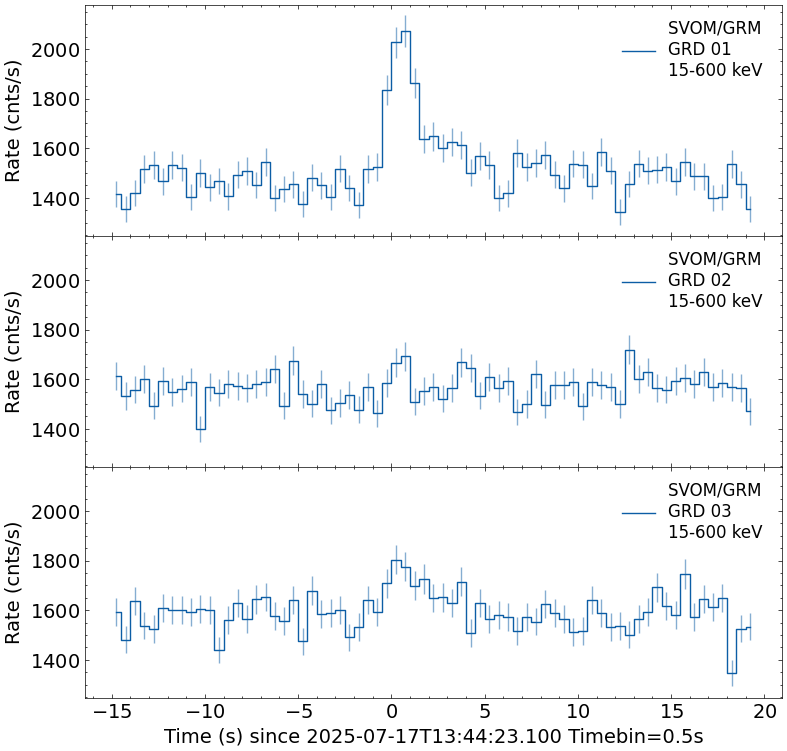
With the event-by-event data downloaded through the X-band ground station, the GRM light curve shows that this burst consists of a single pulse with a T90 of 4.5 +1.5/-2.0 s in the 15-5000 keV band.
The SVOM/GRM light curve can be found here:
https://www.bursthub.cn//admin/static/svgrb250717B.png
In addition, the position of this burst, as determined by Fermi/GBM (RA,Dec = 44.1179, 26.3789, GCN#41110), is located at about 75 degrees from the SVOM optical axis, which is outside the ECLAIRs field of view.
With this localization, the time-averaged spectrum from T0-0.5 to T0+4.5 s is best fitted by a power law function with an exponential high-energy cutoff. The power law index is -1.82 +0.11/-0.21 and the cutoff energy, parameterized as Epeak, is 47 +23/-20 keV. The event fluence (10-1000 keV) in this time interval is (3.54 +0.40/-0.36)E-06 erg/cm^2.
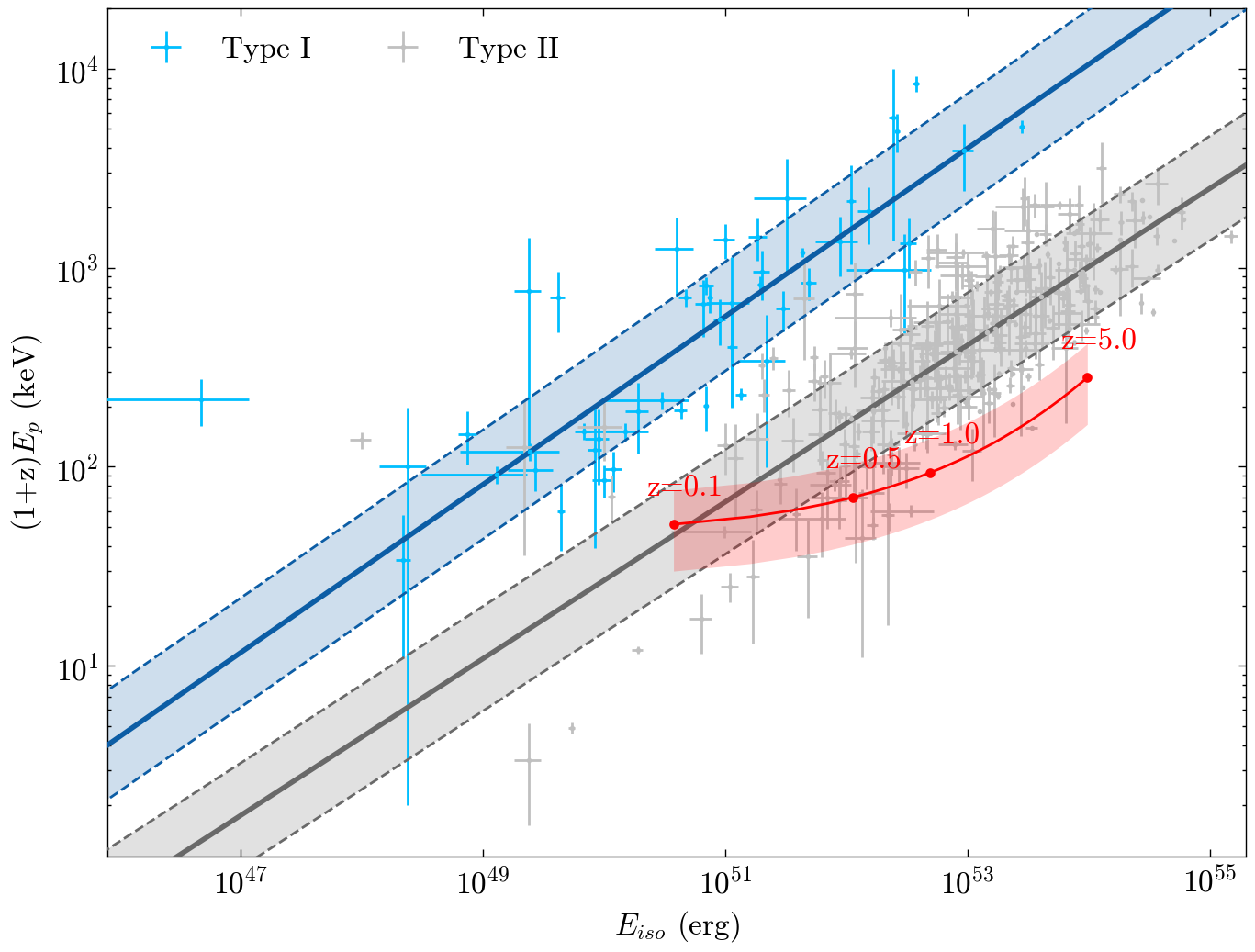
The localization of GRB 250717B in the 'Amati' relation diagram is shown at:
https://www.bursthub.cn//admin/static/grb250717B_amati.png
The Space Variable Objects Monitor (SVOM) is a China-France joint mission led by the Chinese National Space Administration (CNSA, China), National Center for Space Studies (CNES, France) and the Chinese Academy of Sciences (CAS, China), which is dedicated to observing gamma-ray bursts and other transient phenomena in the energetic universe. GRM is developed by the Institute of High Energy Physics (IHEP) of CAS.
The SVOM point of contact for this burst is: Zheng-hang Yu (IHEP)(zhyu@ihep.ac.cn)


 Previous IAU Circulars