- GCN NOTICE
TITLE:           GCN/FERMI NOTICE
NOTICE_DATE:     Tue 02 Dec 25 01:51:21 UT
NOTICE_TYPE:     Fermi-GBM Flight Position
RECORD_NUM:      44
TRIGGER_NUM:     786333057
GRB_RA:          126.717d {+08h 26m 52s} (J2000),
                 127.156d {+08h 28m 37s} (current),
                 125.867d {+08h 23m 28s} (1950)
GRB_DEC:         +42.867d {+42d 52' 00"} (J2000),
                 +42.780d {+42d 46' 48"} (current),
                 +43.031d {+43d 01' 53"} (1950)
GRB_ERROR:       32.17 [deg radius, statistical plus systematic]
GRB_INTEN:       43 [cnts/sec]
DATA_SIGNIF:     4.50 [sigma]
INTEG_TIME:      4.096 [sec]
GRB_DATE:        21011 TJD;   336 DOY;   25/12/02
GRB_TIME:        6652.31 SOD {01:50:52.31} UT
GRB_PHI:         231.00 [deg]
GRB_THETA:        70.00 [deg]
DATA_TIME_SCALE: 4.0960 [sec]
HARD_RATIO:      1.25
LOC_ALGORITHM:   3 (version number of)
MOST_LIKELY:      97%  GRB
2nd_MOST_LIKELY:   1%  Generic SGR
DETECTORS:       0,0,0, 0,0,0, 0,1,1, 0,0,0, 0,0,
SUN_POSTN:       248.50d {+16h 34m 00s}  -21.96d {-21d 57' 51"}
SUN_DIST:        127.45 [deg]   Sun_angle= 8.1 [hr] (West of Sun)
MOON_POSTN:       25.93d {+01h 43m 44s}  +14.64d {+14d 38' 07"}
MOON_DIST:        88.09 [deg]
MOON_ILLUM:      88 [%]
GAL_COORDS:      177.88, 35.03 [deg] galactic lon,lat of the burst (or transient)
ECL_COORDS:      118.42, 22.98 [deg] ecliptic lon,lat of the burst (or transient)
LC_URL:          http://heasarc.gsfc.nasa.gov/FTP/fermi/data/gbm/triggers/2025/bn251202077/quicklook/glg_lc_medres34_bn251202077.gif
COMMENTS:        Fermi-GBM Flight-calculated Coordinates.
COMMENTS:        This trigger occurred at longitude,latitude = 160.45,20.70 [deg].
COMMENTS:        The LC_URL file will not be created until ~15 min after the trigger.
- GCN NOTICE
TITLE:           GCN/FERMI NOTICE
NOTICE_DATE:     Tue 02 Dec 25 01:51:30 UT
NOTICE_TYPE:     Fermi-GBM Flight Position
RECORD_NUM:      59
TRIGGER_NUM:     786333057
GRB_RA:          129.950d {+08h 39m 48s} (J2000),
                 130.428d {+08h 41m 43s} (current),
                 129.024d {+08h 36m 06s} (1950)
GRB_DEC:         +52.933d {+52d 55' 60"} (J2000),
                 +52.840d {+52d 50' 25"} (current),
                 +53.110d {+53d 06' 37"} (1950)
GRB_ERROR:       9.38 [deg radius, statistical plus systematic]
GRB_INTEN:       153 [cnts/sec]
DATA_SIGNIF:     16.30 [sigma]
INTEG_TIME:      4.096 [sec]
GRB_DATE:        21011 TJD;   336 DOY;   25/12/02
GRB_TIME:        6652.31 SOD {01:50:52.31} UT
GRB_PHI:         231.98 [deg]
GRB_THETA:        60.00 [deg]
DATA_TIME_SCALE: 4.0960 [sec]
HARD_RATIO:      1.03
LOC_ALGORITHM:   3 (version number of)
MOST_LIKELY:      97%  GRB
2nd_MOST_LIKELY:   1%  Generic SGR
DETECTORS:       0,0,0, 0,0,0, 0,1,1, 0,0,0, 0,0,
SUN_POSTN:       248.50d {+16h 34m 00s}  -21.96d {-21d 57' 51"}
SUN_DIST:        124.17 [deg]   Sun_angle= 7.9 [hr] (West of Sun)
MOON_POSTN:       25.93d {+01h 43m 44s}  +14.64d {+14d 38' 09"}
MOON_DIST:        86.84 [deg]
MOON_ILLUM:      88 [%]
GAL_COORDS:      165.46, 37.45 [deg] galactic lon,lat of the burst (or transient)
ECL_COORDS:      117.57, 33.25 [deg] ecliptic lon,lat of the burst (or transient)
LC_URL:          http://heasarc.gsfc.nasa.gov/FTP/fermi/data/gbm/triggers/2025/bn251202077/quicklook/glg_lc_medres34_bn251202077.gif
COMMENTS:        Fermi-GBM Flight-calculated Coordinates.
COMMENTS:        This trigger occurred at longitude,latitude = 160.45,20.70 [deg].
COMMENTS:        The LC_URL file will not be created until ~15 min after the trigger.
- GCN NOTICE
TITLE:           GCN/FERMI NOTICE
NOTICE_DATE:     Tue 02 Dec 25 01:51:40 UT
NOTICE_TYPE:     Fermi-GBM Ground Position
RECORD_NUM:      58
TRIGGER_NUM:     786333057
GRB_RA:          116.550d {+07h 46m 12s} (J2000),
                 117.018d {+07h 48m 04s} (current),
                 115.645d {+07h 42m 35s} (1950)
GRB_DEC:         +46.600d {+46d 36' 00"} (J2000),
                 +46.535d {+46d 32' 06"} (current),
                 +46.722d {+46d 43' 21"} (1950)
GRB_ERROR:       7.87 [deg radius, statistical only]
DATA_SIGNIF:     11.00 [sigma]
DATA_INTERVAL:   2.048 [sec]
GRB_DATE:        21011 TJD;   336 DOY;   25/12/02
GRB_TIME:        6652.31 SOD {01:50:52.31} UT
GRB_PHI:         223.00 [deg]
GRB_THETA:        67.00 [deg]
E_RANGE:         44.032 - 279.965 [keV]
LOC_ALGORITHM:   4173 (Gnd S/W Version number)
SUN_POSTN:       248.50d {+16h 34m 00s}  -21.96d {-21d 57' 51"}
SUN_DIST:        133.95 [deg]   Sun_angle= 8.8 [hr] (West of Sun)
MOON_POSTN:       25.94d {+01h 43m 45s}  +14.64d {+14d 38' 12"}
MOON_DIST:        80.16 [deg]
MOON_ILLUM:      88 [%]
GAL_COORDS:      172.32, 28.43 [deg] galactic lon,lat of the burst (or transient)
ECL_COORDS:      109.80, 24.97 [deg] ecliptic lon,lat of the burst (or transient)
LC_URL:          http://heasarc.gsfc.nasa.gov/FTP/fermi/data/gbm/triggers/2025/bn251202077/quicklook/glg_lc_medres34_bn251202077.gif
POS_MAP_URL:     http://gcn.gsfc.nasa.gov/notices_f/gbm_gnd_loc_map_786333057.fits
COMMENTS:        Fermi-GBM Ground-calculated Coordinates.
COMMENTS:        This Notice was ground-generated -- not flight-generated.
COMMENTS:        The LC_URL file will not be created/available until ~15 min after the trigger.
COMMENTS:        The POS_MAP_URL file will not be created/available until ~1.5 min after the notice.
- GCN NOTICE
TITLE:           GCN/FERMI NOTICE
NOTICE_DATE:     Tue 02 Dec 25 01:52:21 UT
NOTICE_TYPE:     Fermi-GBM Ground Position
RECORD_NUM:      0
TRIGGER_NUM:     786333057
GRB_RA:          126.270d {+08h 25m 05s} (J2000),
                 126.699d {+08h 26m 48s} (current),
                 125.440d {+08h 21m 46s} (1950)
GRB_DEC:         +39.930d {+39d 55' 48"} (J2000),
                 +39.844d {+39d 50' 39"} (current),
                 +40.093d {+40d 05' 35"} (1950)
GRB_ERROR:       6.02 [deg radius, statistical only]
DATA_SIGNIF:     13.50 [sigma]
DATA_INTERVAL:   10.240 [sec]
GRB_DATE:        21011 TJD;   336 DOY;   25/12/02
GRB_TIME:        6652.31 SOD {01:50:52.31} UT
GRB_PHI:         231.00 [deg]
GRB_THETA:        73.00 [deg]
E_RANGE:         44.032 - 279.965 [keV]
LOC_ALGORITHM:   41731 (Gnd S/W Version number)
SUN_POSTN:       248.50d {+16h 34m 00s}  -21.96d {-21d 57' 52"}
SUN_DIST:        127.94 [deg]   Sun_angle= 8.1 [hr] (West of Sun)
MOON_POSTN:       25.94d {+01h 43m 46s}  +14.64d {+14d 38' 22"}
MOON_DIST:        88.67 [deg]
MOON_ILLUM:      88 [%]
GAL_COORDS:      181.37, 34.32 [deg] galactic lon,lat of the burst (or transient)
ECL_COORDS:      118.88, 20.06 [deg] ecliptic lon,lat of the burst (or transient)
LC_URL:          http://heasarc.gsfc.nasa.gov/FTP/fermi/data/gbm/triggers/2025/bn251202077/quicklook/glg_lc_medres34_bn251202077.gif
POS_MAP_URL:     http://gcn.gsfc.nasa.gov/notices_f/gbm_gnd_loc_map_786333057.fits
COMMENTS:        Fermi-GBM Ground-calculated Coordinates.
COMMENTS:        This is likely a Long GRB.
COMMENTS:        This Notice was ground-generated -- not flight-generated.
COMMENTS:        The LC_URL file will not be created/available until ~15 min after the trigger.
COMMENTS:        The POS_MAP_URL file will not be created/available until ~1.5 min after the notice.
- GCN NOTICE
TITLE:           GCN/FERMI NOTICE
NOTICE_DATE:     Tue 02 Dec 25 01:52:32 UT
NOTICE_TYPE:     Fermi-GBM Ground Position
RECORD_NUM:      1
TRIGGER_NUM:     786333057
GRB_RA:          122.420d {+08h 09m 41s} (J2000),
                 122.851d {+08h 11m 24s} (current),
                 121.586d {+08h 06m 21s} (1950)
GRB_DEC:         +39.240d {+39d 14' 24"} (J2000),
                 +39.162d {+39d 09' 44"} (current),
                 +39.388d {+39d 23' 15"} (1950)
GRB_ERROR:       5.00 [deg radius, statistical only]
DATA_SIGNIF:     18.30 [sigma]
DATA_INTERVAL:   12.288 [sec]
GRB_DATE:        21011 TJD;   336 DOY;   25/12/02
GRB_TIME:        6652.31 SOD {01:50:52.31} UT
GRB_PHI:         228.00 [deg]
GRB_THETA:        74.00 [deg]
E_RANGE:         44.032 - 279.965 [keV]
LOC_ALGORITHM:   41731 (Gnd S/W Version number)
SUN_POSTN:       248.50d {+16h 34m 00s}  -21.96d {-21d 57' 52"}
SUN_DIST:        130.94 [deg]   Sun_angle= 8.4 [hr] (West of Sun)
MOON_POSTN:       25.94d {+01h 43m 47s}  +14.64d {+14d 38' 25"}
MOON_DIST:        86.02 [deg]
MOON_ILLUM:      88 [%]
GAL_COORDS:      181.57, 31.28 [deg] galactic lon,lat of the burst (or transient)
ECL_COORDS:      116.00, 18.68 [deg] ecliptic lon,lat of the burst (or transient)
LC_URL:          http://heasarc.gsfc.nasa.gov/FTP/fermi/data/gbm/triggers/2025/bn251202077/quicklook/glg_lc_medres34_bn251202077.gif
POS_MAP_URL:     http://gcn.gsfc.nasa.gov/notices_f/gbm_gnd_loc_map_786333057.fits
COMMENTS:        Fermi-GBM Ground-calculated Coordinates.
COMMENTS:        This is likely a Long GRB.
COMMENTS:        This Notice was ground-generated -- not flight-generated.
COMMENTS:        The LC_URL file will not be created/available until ~15 min after the trigger.
COMMENTS:        The POS_MAP_URL file will not be created/available until ~1.5 min after the notice.
- GCN NOTICE
TITLE:           GCN/FERMI NOTICE
NOTICE_DATE:     Tue 02 Dec 25 01:52:42 UT
NOTICE_TYPE:     Fermi-GBM Ground Position
RECORD_NUM:      2
TRIGGER_NUM:     786333057
GRB_RA:          122.630d {+08h 10m 31s} (J2000),
                 123.068d {+08h 12m 16s} (current),
                 121.782d {+08h 07m 08s} (1950)
GRB_DEC:         +41.300d {+41d 17' 60"} (J2000),
                 +41.222d {+41d 13' 18"} (current),
                 +41.448d {+41d 26' 54"} (1950)
GRB_ERROR:       3.90 [deg radius, statistical only]
DATA_SIGNIF:     24.40 [sigma]
DATA_INTERVAL:   16.384 [sec]
GRB_DATE:        21011 TJD;   336 DOY;   25/12/02
GRB_TIME:        6652.31 SOD {01:50:52.31} UT
GRB_PHI:         228.00 [deg]
GRB_THETA:        72.00 [deg]
E_RANGE:         44.032 - 279.965 [keV]
LOC_ALGORITHM:   41731 (Gnd S/W Version number)
SUN_POSTN:       248.50d {+16h 34m 00s}  -21.96d {-21d 57' 52"}
SUN_DIST:        130.61 [deg]   Sun_angle= 8.4 [hr] (West of Sun)
MOON_POSTN:       25.95d {+01h 43m 47s}  +14.64d {+14d 38' 28"}
MOON_DIST:        85.62 [deg]
MOON_ILLUM:      88 [%]
GAL_COORDS:      179.23, 31.81 [deg] galactic lon,lat of the burst (or transient)
ECL_COORDS:      115.67, 20.72 [deg] ecliptic lon,lat of the burst (or transient)
LC_URL:          http://heasarc.gsfc.nasa.gov/FTP/fermi/data/gbm/triggers/2025/bn251202077/quicklook/glg_lc_medres34_bn251202077.gif
POS_MAP_URL:     http://gcn.gsfc.nasa.gov/notices_f/gbm_gnd_loc_map_786333057.fits
COMMENTS:        Fermi-GBM Ground-calculated Coordinates.
COMMENTS:        This is likely a Long GRB.
COMMENTS:        This Notice was ground-generated -- not flight-generated.
COMMENTS:        The LC_URL file will not be created/available until ~15 min after the trigger.
COMMENTS:        The POS_MAP_URL file will not be created/available until ~1.5 min after the notice.
- GCN NOTICE
TITLE:           GCN/FERMI NOTICE
NOTICE_DATE:     Tue 02 Dec 25 01:52:53 UT
NOTICE_TYPE:     Fermi-GBM Ground Position
RECORD_NUM:      3
TRIGGER_NUM:     786333057
GRB_RA:          122.620d {+08h 10m 29s} (J2000),
                 123.059d {+08h 12m 14s} (current),
                 121.771d {+08h 07m 05s} (1950)
GRB_DEC:         +41.380d {+41d 22' 48"} (J2000),
                 +41.302d {+41d 18' 06"} (current),
                 +41.528d {+41d 31' 42"} (1950)
GRB_ERROR:       3.12 [deg radius, statistical only]
DATA_SIGNIF:     25.20 [sigma]
DATA_INTERVAL:   21.504 [sec]
GRB_DATE:        21011 TJD;   336 DOY;   25/12/02
GRB_TIME:        6652.31 SOD {01:50:52.31} UT
GRB_PHI:         228.00 [deg]
GRB_THETA:        72.00 [deg]
E_RANGE:         44.032 - 279.965 [keV]
LOC_ALGORITHM:   41731 (Gnd S/W Version number)
SUN_POSTN:       248.50d {+16h 34m 00s}  -21.96d {-21d 57' 52"}
SUN_DIST:        130.61 [deg]   Sun_angle= 8.4 [hr] (West of Sun)
MOON_POSTN:       25.95d {+01h 43m 47s}  +14.64d {+14d 38' 30"}
MOON_DIST:        85.59 [deg]
MOON_ILLUM:      88 [%]
GAL_COORDS:      179.14, 31.82 [deg] galactic lon,lat of the burst (or transient)
ECL_COORDS:      115.64, 20.80 [deg] ecliptic lon,lat of the burst (or transient)
LC_URL:          http://heasarc.gsfc.nasa.gov/FTP/fermi/data/gbm/triggers/2025/bn251202077/quicklook/glg_lc_medres34_bn251202077.gif
POS_MAP_URL:     http://gcn.gsfc.nasa.gov/notices_f/gbm_gnd_loc_map_786333057.fits
COMMENTS:        Fermi-GBM Ground-calculated Coordinates.
COMMENTS:        This is likely a Long GRB.
COMMENTS:        This Notice was ground-generated -- not flight-generated.
COMMENTS:        The LC_URL file will not be created/available until ~15 min after the trigger.
COMMENTS:        The POS_MAP_URL file will not be created/available until ~1.5 min after the notice.
- GCN NOTICE
TITLE:           GCN/FERMI NOTICE
NOTICE_DATE:     Tue 02 Dec 25 02:00:14 UT
NOTICE_TYPE:     Fermi-GBM Final Position
RECORD_NUM:      0
TRIGGER_NUM:     786333057
GRB_RA:          120.270d {+08h 01m 05s} (J2000),
                 120.720d {+08h 02m 53s} (current),
                 119.400d {+07h 57m 36s} (1950)
GRB_DEC:         +43.480d {+43d 28' 48"} (J2000),
                 +43.407d {+43d 24' 24"} (current),
                 +43.619d {+43d 37' 07"} (1950)
GRB_ERROR:       2.79 [deg radius, statistical only]
GRB_DATE:        21011 TJD;   336 DOY;   25/12/02
GRB_TIME:        6652.31 SOD {01:50:52.31} UT
GRB_PHI:         226.00 [deg]
GRB_THETA:        70.00 [deg]
E_RANGE:         44.032 - 279.965 [keV]
LOC_ALGORITHM:   41731 (Gnd S/W Version number)
SUN_POSTN:       248.51d {+16h 34m 02s}  -21.97d {-21d 57' 54"}
SUN_DIST:        132.06 [deg]   Sun_angle= 8.5 [hr] (West of Sun)
MOON_POSTN:       26.02d {+01h 44m 05s}  +14.67d {+14d 40' 22"}
MOON_DIST:        83.31 [deg]
MOON_ILLUM:      88 [%]
GAL_COORDS:      176.37, 30.46 [deg] galactic lon,lat of the burst (or transient)
ECL_COORDS:      113.32, 22.46 [deg] ecliptic lon,lat of the burst (or transient)
LC_URL:          http://heasarc.gsfc.nasa.gov/FTP/fermi/data/gbm/triggers/2025/bn251202077/quicklook/glg_lc_medres34_bn251202077.gif
LOC_URL:         http://heasarc.gsfc.nasa.gov/FTP/fermi/data/gbm/triggers/2025/bn251202077/quicklook/glg_locplot_all_bn251202077.png
COMMENTS:        Fermi-GBM Final Position.
COMMENTS:        This Notice was ground-generated -- not flight-generated.
COMMENTS:        The LC_URL file should be available by the time this FINAL notice is produced.
COMMENTS:        This notice was generated completely by automated pipeline processing.
COMMENTS:        This is likely a Long GRB.
- GCN Circular #42933
The Fermi GBM team reports the detection of a likely LONG GRB
At 01:50:52 UT on 2 Dec 2025, the Fermi Gamma-ray Burst Monitor (GBM) triggered and located GRB 251202A (trigger 786333057.306028 / 251202077).
The on-ground calculated location, using the Fermi GBM trigger data, is RA = 120.3, Dec = 43.5 (J2000 degrees, equivalent to J2000 08h 01m, 43d 30'), with a statistical uncertainty of 2.8 degrees.
The angle from the Fermi LAT boresight is 70.0 degrees.
The skymap can be found here:
https://heasarc.gsfc.nasa.gov/FTP/fermi/data/gbm/triggers/2025/bn251202077/quicklook/glg_skymap_all_bn251202077.png
The HEALPix FITS file, including the estimated localization systematic, can be found here:
https://heasarc.gsfc.nasa.gov/FTP/fermi/data/gbm/triggers/2025/bn251202077/quicklook/glg_healpix_all_bn251202077.fit
The GBM light curve can be found here:
https://heasarc.gsfc.nasa.gov/FTP/fermi/data/gbm/triggers/2025/bn251202077/quicklook/glg_lc_medres34_bn251202077.gif

- GCN Circular #42934
Wenxiong Li, Runduo Liang (NAOC), Iair Arcavi (TAU), Ido Keinan (TAU), David Sand (U of Arizona)
We observed the position of The EP-WXT trigger 01709249064 with a Las Cumbres 1m telescope at Teide Observatory, Tenerife, 18 mins after the Einstein Probe WXT trigger. We took 2x300s exposures in the broad optical w band.
We find a uncataloged source at RA=122.1143 Dec=40.6123 within the EP/WXT error circle and measure the following preliminary photometry calibrated to the r band:
MJD 61011.089 Mag 15.6
We find a faint red likely extended source at this position in Legacy Survey data (https://www.legacysurvey.org/viewer).
Additional followup is encouraged.
- GCN Circular #42937
Y. J. Zhang (THU), R. D. Liang (NAOC) Z. M. Wang (BNU), Y. Wu (NJU), H. N. Yang, H. Sun (NAOC) on behalf of the Einstein Probe (EP) team:
We report on the detection of an X-ray transient by the Wide-field X-ray Telescope (WXT) on board the Einstein Probe (EP) mission, designated EP251202a. The transient triggered EP-WXT (ID: 01709249064) at 2025-12-02T01:49:15 (UTC). The WXT position of the source is R.A. = 122.121 deg, DEC = 40.600 deg (J2000) with an uncertainty of 3 arcmin in radius (90% C.L. statistical and systematic). The trigger time and the position of the transient is consistent with that of GRB 251202A detected by Fermi/GBM (GCN 42933).
We performed a follow-up observation with the Follow-up X-ray Telescope (FXT), starting at 2025-12-02T02:09:51 (UTC), about 20 minutes after the trigger. Within the WXT error circle, an uncatalogued X-ray source was detected at R.A. = 122.1190 deg, DEC = 40.6125 deg (J2000) with an uncertainty of 20 arcsec in radius (90% C.L. statistical and systematic). The position is 12 arcsec from the optical counterpart reported by Las Cumbres Observatory (Li et al., GCN 42934). Further information will be updated when the telemetry data is received.
Launched on January 9, 2024, EP is a space X-ray observatory to monitor the soft X-ray sky with X-ray follow-up capability (Yuan et al. 2022, Handbook of X-ray and Gamma-ray Astrophysics).
- GCN Circular #42938
V.Lipunov, E.Gorbovskoy, A.Kuznetsov, K.Zhirkov, I.Panchenko, N.Tiurina, P.Balanutsa, V.Topolev, D.Vlasenko,
G.Antipov, A.Sankovich, Yu.Tselik, Ya.Kechin, V.Senik, A.Chasovnikov, K.Labsina, I. Gorbunov (Lomonosov MSU),
O.Gress, N.Budnev (ISU),
C.Francile, F. Podesta, R.Podesta, E. Gonzalez (Observatorio Astronomico Felix Aguilar (OAFA),
A. Tlatov, D. Dormidontov (Kislovodsk Solar Station of the Pulkovo Observatory),
A.Sosnovskij (CrAO),
A. Gabovich, V.Yurkov (Blagoveschensk Educational StateUniversity),
D.Buckley (SAAO),
R.Rebolo (The Instituto de Astrofisica de Canarias),
L.Carrasco, J.R.Valdes, V.Chavushyan, V.M.Patino Alvarez, J.Martinez,
A.R.Corella, L.H.Rodriguez (INAOE, Guillermo Haro Astrophysics Observatory)
MASTER-SAAO robotic telescope [1] located in South Africa (South African Astronomical Observatory) started inspect of the Fermi GRB 251202A ( Fermi GBM team, GCN 42933) errorbox 570 sec after notice time and 604 sec after trigger time at 2025-12-02 02:00:56 UT, with upper limit up to 18.8 mag. Observations started at twilight. The observations began at zenith distance = 76 deg. The sun altitude is -15.8 deg.
The galactic latitude b = 31 deg., longitude l = 177 deg.
Real time updated cover map and OT discovered available here:
https://master.sai.msu.ru/site/master2/observ.php?id=3057770
We obtain a following upper limits.
Tmid-T0  |      Date Time      |          Site       |             Coord (J2000)          |Filt.| Expt. | Limit| Comment
_________|_____________________|_____________________|____________________________________|_____|_______|_______|________

     634 | 2025-12-02 02:00:56 |         MASTER-SAAO | (07h 56m 46.47s , +43d 37m 13.0s) |   C |    60 | 17.7 |
     694 | 2025-12-02 02:00:56 |         MASTER-SAAO | (07h 56m 46.46s , +43d 37m 13.0s) |   C |   180 | 18.6 |  Coadd
     634 | 2025-12-02 02:00:56 |         MASTER-SAAO | (07h 59m 07.79s , +43d 21m 09.1s) |   C |    60 | 18.0 |
     694 | 2025-12-02 02:00:56 |         MASTER-SAAO | (07h 59m 07.80s , +43d 21m 09.1s) |   C |   180 | 18.8 |  Coadd
Filter C is a clear (unfiltred) band.
The observation and reduction will continue.
The message may be cited.
[1] - V.M. Lipunov, V.G. Kornilov, E.S. Gorbovskoy, N.A. Tiurina & A.S.Kuznetsov, 2023, Astronomical Robotic Networks and Operative Multichanel Astrophysics, Lomonosov MSU PRESS, 591pp.
http : // www.pereplet.ru/lipunov/625.html
- GCN Circular #42939
Z.P. Zhu (NAOC), D. B. Malesani (DAWN/NBI and Radboud), L. Izzo (INAF/OACN and DARK/NBI), A. de Ugarte Postigo (LAM), D. Xu, X. Liu, S.Q. Jiang, J. An, L.B. He (NAOC), A. Saccardi (CEA/Irfu), R. H. Rasmussen (NOT and Aarhus) report on behalf of a large collaboration:
We observed the optical counterpart (Li et al., GCN 42934) of EP251202a (Zhang et al., GCN 42937), which is likely the same event of Fermi GRB 251202A (Fermi GBM team, GCN 42933), using the Nordic Optical Telescope (NOT), equipped with the ALFOSC camera and spectrograph.
We obtained 10x120 s and 9x120 s exposures in the r and z bands, respectively, starting on 2025 Dec 2 at 02:51:32 UT. The afterglow is clearly detected in single images, with an AB magnitude of r = 17.27 +/- 0.01 at a mid time of 1.05 hr after the trigger.
A sequence of 3 spectra by 1200 s each was then acquired using grism #4, covering the wavelength range 3500-9500 AA. Our first spectrum started on 2025 Dec 2.156 UT (1.93 hr after the EP/WXT trigger). Continuum is detected across the whole wavelength range. A spectral break is detected around 4610 AA, and the onset of the forest is seen blueward of this wavelength. We match existing features to a low-column density Lyman alpha and C IV (unresolved) at z = 2.785, which we believe to be the redshift of the burst. Intervening systems are also seen in Lyman alpha and C IV at z = 2.450 and 2.356.
We acknowledge the use of the grbspec.eu tool to analyse this spectrum.
- GCN Circular #42943
B. Sbarufatti (INAF-OAB), S. Lanava (PSU), S. Dichiara (PSU), J.A.
Kennea (PSU), J.P. Osborne (U. Leicester), K.L. Page (U. Leicester),
A.P. Beardmore (U. Leicester), C. Salvaggio (INAF-OAB), M. Ferro
(INAF-OAB) and P.A. Evans (U. Leicester) reports on behalf of the
Swift-XRT team:
Swift-XRT has performed follow-up observations of GRB 251202A. We
searched for X-ray sources in 759 s of Photon Counting (PC) mode data.
The total exposure at the position of the afterglow (see below) is 759
s, obtained between T0+2.4 ks and T0+24.0 ks.
An uncatalogued X-ray source are clearly detected within the Einstein
Probe/WXT error region. Using 411 s of PC mode data and 1 UVOT image,
we find an enhanced XRT position (using the XRT-UVOT alignment and
matching UVOT field sources to the USNO-B1 catalogue): RA, Dec =
122.11512, +40.61228 which is equivalent to:
RA (J2000): 08h 08m 27.63s
Dec(J2000): +40d 36' 44.2"
with an uncertainty of 2.4 arcsec (radius, 90% confidence). This
position is 10.3 arcsec from the EP/FXT position (Zhang et al., GCN
Circ. 42937) and 2.2 arcsec from the optical counterpart reported by Li
et al. (GCN 42934).
The light curve can be modelled with a power-law decay with a decay
index of alpha=1.08 (+0.33, -0.24).
A spectrum formed from the PC mode data can be fitted with an absorbed
power-law with a photon spectral index of 1.93 (+0.45, -0.22). The
best-fitting absorption column is consistent with the Galactic value
of 6.5 x 10^20 cm^-2 (Willingale et al. 2013). The counts to observed
(unabsorbed) 0.3-10 keV flux conversion factor deduced from this
spectrum is 3.4 x 10^-11 (3.9 x 10^-11) erg cm^-2 count^-1.
A summary of the PC-mode spectrum is thus:
Galactic foreground: 6.5 x 10^20 cm^-2
Intrinsic column:    6 (+/-166) x 10^20 cm^-2 at z=2.785
Photon index:	     1.93 (+0.45, -0.22)
If the light curve continues to decay with a power-law decay index of
1.08, the count rate at T+24 hours will be 0.018 count s^-1,
corresponding to an observed (unabsorbed) 0.3-10 keV flux of 6.3 x
10^-13 (7.2 x 10^-13) erg cm^-2 s^-1.
The results of the XRT-team automatic analysis are available at
https://www.swift.ac.uk/xrt_products/03000226.
The results of the full analysis of the XRT observations are available
at https://www.swift.ac.uk/EP/EP_FIELD00086.
This circular is an official product of the Swift-XRT team.
- GCN Circular #42946
R. D. Liang (NAOC) Z. M. Wang (BNU), Y. Wu (NJU), Y. J. Zhang (THU), H. N. Yang, H. Sun (NAOC) on behalf of the Einstein Probe (EP) team:
The fast X-ray transient EP251202a triggered the Wide-field X-ray Telescope (WXT) on board the Einstein Probe (EP) mission (Zhang et al., GCN 42937), and was followed by several telescopes (Li et al., GCN 42934, Lipunov et al., GCN 42938 and Zhu et al., GCN 42939, Sbarufatti et al. GCN 42943). The refined analysis of the WXT data shows that the event started at T0=2025-12-02T01:48:23.9 (UTC) and lasted for ~400 s. Three peaks are detected in the lightcurve, whose spectra are characterized by photon indice of 2.33 (-0.90/+1.02), 1.12 (-0.48/+0.60) and 1.19 (-0.51/+1.1), respectively. The average WXT 0.5-4 keV spectrum can be fitted with an absorbed power law with a fixed Galactic hydrogen column density of 6.48 x 10^20 cm^-2 and a photon index of 1.23 (-0.19/+0.19). The derived average unabsorbed 0.5-4 keV flux is 5.40 (-0.63/+0.70) x 10^(-10) erg/s/cm^2.
Launched on January 9, 2024, EP is a space X-ray observatory to monitor the soft X-ray sky with X-ray follow-up capability (Yuan et al. 2022, Handbook of X-ray and Gamma-ray Astrophysics).
- GCN Circular #42947
D. O’Neill, S. Moran, G. Ramsay, R. Starling, B. P. Gompertz, K. Ackley, M. Dyer, J. Lyman, K. Ulaczyk, D. Steeghs, D. Galloway, V. Dhillon, P. O'Brien, K. Noysena, R. Kotak, R. Breton, J. Casares, L. Nuttall, B. Godson, T. Killestein, A. Kumar and M. Pursiainen report on behalf of GOTO collaboration:
We report on optical observations with the Gravitational-wave Optical Transient Observer (GOTO; Steeghs et al. 2022, Dyer et al. 2024) in response to the GRB 251202A (Fermi GBM team, GCN 42923; Einstein Probe, GCN 42937).
Targeted observations were performed beginning at 2025-12-02 03:00:49 UT, (+1.19h post trigger). Images were processed immediately after acquisition using the GOTO pipeline. Difference imaging was performed using deeper template observations.
We detect the counterpart (Moss et al., GCN 42924; Osborne et al., GCN 42927; Goyal et al., GCN 42925; Li et al., GCN 42931; Sbarufatti et al. GCN 42943) with magnitude L = 17.92 ± 0.04 AB mag (+1.71h), before fading to L = 18.83 ± 0.07 AB mag (+4.3h).
Magnitudes were calibrated using ATLAS-REFCAT2 (Tonry et al. 2018) and not corrected for Galactic extinction.
GOTO (https://goto-observatory.org) is a network of telescopes that is principally funded by the STFC and operated at the Roque de los Muchachos Observatory on La Palma, Spain, and Siding Spring Observatory in NSW, Australia, on behalf of a consortium including the University of Warwick, Monash University, Armagh Observatory & Planetarium, the University of Leicester, the University of Sheffield, the National Astronomical Research Institute of Thailand (NARIT), the University of Turku, the University of Portsmouth, the University of Manchester, the University of Birmingham and the Instituto de Astrofisica de Canarias (IAC).
- GCN Circular #42948
J. Quirola-Vasquez (Radboud), J. Sanchez-Sierras (Radboud), D. B. Malesani (DAWN/NBI and Radboud), G. Corcoran (UCD), A. Martin-Carrillo (UCD), P. G. Jonker (Radboud), A. J. Levan (Radboud and Warwick), J. A. Chacón (PUC), F. E. Bauer (SSI and UTA), J. N. D. van Dalen (Radboud), A. P. C. van Hoof (Radboud) report on behalf of a larger collaboration:
We observed the optical counterpart (Li et al., GCN 42934) of EP251202a (Zhang et al., GCN 42937, Liang et al., GCN 42946) and Fermi GRB 251202A (Fermi GBM team, GCN 42933) with a spectroscopic redshift of z = 2.785 (Zhu et al., GCN 42939) using the Las Cumbres Observatory (LCO) network at the McDonald Observatory, equipped with the SINISTRO camera. Observations were obtained in the r (6x200 s) and i (6x200 s) bands, starting on 2025-12-02 at 09:00:43 UTC (i.e., a mid-time observation of 7.35 and 7.75 hr after the EP/WXT trigger, respectively).
Calibrated to nearby stars from the Pan-STARRS catalog, we measure AB magnitudes r = 19.22 +/- 0.06 and i = 19.12 +/- 0.06, not corrected for Galactic extinction.
- GCN Circular #42956
N.P.M. Kuin (UCL-MSSL) and M. J. Moss (GSFC) report on behalf of the
Swift/UVOT team:
The Swift/UVOT began settled observations of the field of EP251202a/GRB
251202A 17,500s after the EP trigger (Zhang et al., GCN Circ. No 42937).
A source consistent with Li et al. (GCN Circ No 42934) and the XRT
position (Sbarufatti
et al. GCN Circ. No. 42943) is detected in the initial UVOT exposures.
The preliminary UVOT position is:
RA (J2000) = 08:08:27.5 = 122.11420 (deg.)
Dec (J2000) = 40:36:45.3 = 40.61244 (deg.)
with an estimated uncertainty of 0.48 arc sec. (radius, 90% confidence).
Preliminary detections and 3-sigma upper limits using the UVOT photometric
system
(Breeveld et al. 2011, AIP Conf. Proc. 1358, 373) for the early exposures
are:
Filter         T_start(s)   T_stop(s)      Exp(s)           Mag

u                17500         18104         509          19.80 +/- 0.20
u                23697         24044         342         20.26 +/- 0.39
u                28710         28841         129         20.06 +/- 0.53
The magnitudes in the table are not corrected for the Galactic extinction
due to the reddening of E(B-V) = 0.043 in the direction of the burst
(Schlegel et al. 1998).
- GCN Circular #42957
S. Bala (USRA) reports on behalf of the Fermi Gamma-ray Burst Monitor Team:
"At 01:50:52.31 UT on 02 December 2025, the Fermi Gamma-ray Burst Monitor (GBM)
triggered and located GRB 251202A (GCN trigger 786333057/251202077),
which was also detected by Einstein Probe (Y. J. Zhang et al. 2025, GCN 42937),
Swift XRT (B. Sbarufatti et al. 2025, GCN 42943), Swift UVOT (N.P.M. Kuin et al. 2025, GCN 42956)
GOTO (D. O’Neill et al. 2025, GCN 42947) and LCO (J. Quirola-Vasquez et al. 2025, GCN 42948).
The spectroscopic redshift of GRB 251202A is found to be 2.785 by NOT (Z.P. Zhu et al. 2025, GCN 42939).
The Fermi GBM Final Real-time Localization (GCN 42933) is consistent with the position reported by other instruments.
The angle from the Fermi LAT boresight is 73 degrees.
The GBM light curve consists of a single emission episode with a duration (T90)
of about 43 s (50-300 keV). The time-averaged spectrum
from T0-10 to T0+55 s is best fit by
a power law function with an exponential high-energy cutoff.
The power law index is -1.07 +/- 0.06 and the cutoff energy,
parameterized as Epeak, is 350 +/- 50 keV.
The event fluence (10-1000 keV) in this time interval is
(9.9 +/- 0.6)E-06 erg/cm^2. The 1-sec peak photon flux measured
starting from T0+8.8 s in the 10-1000 keV band is 4.2 +/- 0.2 ph/s/cm^2.
The spectral analysis results presented above are preliminary;
final results will be published in the GBM GRB Catalog:
https://heasarc.gsfc.nasa.gov/W3Browse/fermi/fermigbrst.html
For Fermi GBM data and info, please visit the official Fermi GBM Support Page:
https://fermi.gsfc.nasa.gov/ssc/data/access/gbm/"
- GCN Circular #42962
V.Lipunov, E.Gorbovskoy, A.Kuznetsov, K.Zhirkov, I.Panchenko, N.Tiurina, P.Balanutsa, V.Topolev, D.Vlasenko,
G.Antipov, A.Sankovich, Yu.Tselik, Ya.Kechin, V.Senik, A.Chasovnikov, K.Labsina, I. Gorbunov (Lomonosov MSU),
O.Gress, N.Budnev (ISU),
C.Francile, F. Podesta, R.Podesta, E. Gonzalez (Observatorio Astronomico Felix Aguilar (OAFA),
A. Tlatov, D. Dormidontov (Kislovodsk Solar Station of the Pulkovo Observatory),
A.Sosnovskij (CrAO),
A. Gabovich, V.Yurkov (Blagoveschensk Educational StateUniversity),
D.Buckley (SAAO),
R.Rebolo (The Instituto de Astrofisica de Canarias),
L.Carrasco, J.R.Valdes, V.Chavushyan, V.M.Patino Alvarez, J.Martinez,
A.R.Corella, L.H.Rodriguez (INAOE, Guillermo Haro Astrophysics Observatory)
MASTER-SAAO robotic telescope [1] located in South Africa (South African Astronomical Observatory) started inspect of the Fermi GRB 251202B ( Fermi GBM team, GCN 42961) errorbox 566 sec after notice time and 598 sec after trigger time at 2025-12-02 18:37:01 UT, with upper limit up to 19.2 mag. Observations started at twilight. The observations began at zenith distance = 24 deg. The sun altitude is -12.7 deg.
The galactic latitude b = -67 deg., longitude l = 38 deg.
Real time updated cover map and OT discovered available here:
https://master.sai.msu.ru/site/master2/observ.php?id=3058648
We obtain a following upper limits.
Tmid-T0  |      Date Time      |          Site       |             Coord (J2000)          |Filt.| Expt. | Limit| Comment
_________|_____________________|_____________________|____________________________________|_____|_______|_______|________

     629 | 2025-12-02 18:37:01 |         MASTER-SAAO | (23h 04m 42.90s , -23d 23m 21.3s) |   C |    60 | 17.6 |
     629 | 2025-12-02 18:37:01 |         MASTER-SAAO | (23h 06m 42.31s , -23d 38m 56.2s) |   C |    60 | 18.4 |
     689 | 2025-12-02 18:37:01 |         MASTER-SAAO | (23h 06m 42.31s , -23d 38m 56.2s) |   C |   180 | 19.2 |  Coadd
     708 | 2025-12-02 18:38:20 |         MASTER-SAAO | (23h 04m 42.92s , -23d 23m 16.2s) |   C |    60 | 17.6 |
     708 | 2025-12-02 18:38:20 |         MASTER-SAAO | (23h 06m 42.32s , -23d 38m 51.7s) |   C |    60 | 18.4 |
     787 | 2025-12-02 18:39:39 |         MASTER-SAAO | (23h 04m 42.96s , -23d 23m 12.1s) |   C |    60 | 17.7 |
     787 | 2025-12-02 18:39:40 |         MASTER-SAAO | (23h 06m 42.35s , -23d 38m 48.1s) |   C |    60 | 18.4 |
     866 | 2025-12-02 18:40:58 |         MASTER-SAAO | (23h 04m 43.00s , -23d 23m 08.4s) |   C |    60 | 17.7 |
     866 | 2025-12-02 18:40:58 |         MASTER-SAAO | (23h 06m 42.37s , -23d 38m 45.0s) |   C |    60 | 18.5 |
Filter C is a clear (unfiltred) band.
The observation and reduction will continue.
The message may be cited.
[1] - V.M. Lipunov, V.G. Kornilov, E.S. Gorbovskoy, N.A. Tiurina & A.S.Kuznetsov, 2023, Astronomical Robotic Networks and Operative Multichanel Astrophysics, Lomonosov MSU PRESS, 591pp.
http : // www.pereplet.ru/lipunov/625.html
- GCN Circular #42964
WeiKang Zheng (UCB), Xuhui Han (NAOC), Pinpin Zhang (NAOC) and
Alexei V. Filippenko (UCB) report on behalf of the KAIT GRB team:
The 0.76-m Katzman Automatic Imaging Telescope (KAIT), located at
Lick Observatory, observed the field of EP251202a/GRB 251202A
(Zhang et al., GCN 42937; Liang et al., GCN 42946; Fermi GBM team,
GCN 42933; Bala et al., GCN 42957) from 6.29 to 10.59 hours
after the burst. A set of 60s clear (roughly R) filter images
were obtained. We clearly detected the optical afterglow (Li
et al., GCN 42934; Zhu et al., GCN 42939; O’Neill et al., GCN
42947; Quirola-Vasquez et al., GCN 42948; Kuin et al., GCN 42956)
in our coadd images. We measure its brightness decayed from
18.7 +/- 0.1 mag (Vega; mid time 6.30 hours) to 19.3 +/- 0.2 mag
(mid time of 10.55 hours) with a power-law decay index of 1.07.
- GCN Circular #42966
Y. N. Ma, Y. L. Qiu, C. Wu, H. L. Li, L. P. Xin, Z. H. Yao, X. H. Han, Y. Xu, J. Wang, P. P. Zhang, W. J. Xie, Y. J. Xiao, H. B. Cai, L. Lan, J. R. Xu, J. S. Deng, J. Y. Wei (NAOC), J. Palmerio (CEA), J. X. Cao, X. Tian (GXU), Y. Wang (PMO) report on behalf of the SVOM/VT team.
SVOM/VT performed Target of Opportunity observations of GRB 251202A / EP251202a triggered by Fermi/GBM (Fermi GBM team, GCN 42933; Bala et al., GCN 42957) and EP/WXT (Zhang et al., GCN 42937; Liang et al., GCN 42946). The observation began at 2025-12-02T06:43:31 UTC, 4.905 hours after the trigger, in the VT_B (400nm-650nm) and VT_R (650nm-1000nm) channels simultaneously.
With X-band data available, the optical counterpart (Li et al., GCN 42934; Zhu et al., GCN 42939; O’Neill et al., GCN 42947; Quirola-Vasquez et al., GCN 42948; Kuin & Moss, GCN 42956; Zheng et al., GCN 42964) was clearly detected within EP/FXT and Swift/XRT's errorbox (Zhang et al., GCN 42937; Sbarufatti et al., GCN 42943) in both VT_B and VT_R bands. The measurements in AB magnitude are as below:
mid time (h) | exposure time (s) | band | mag (AB) | mag err
-------------|-------------------|------|----------|--------
    5.307    |      22*50        | VT_B |  19.29   |  0.03
    5.300    |      24*50        | VT_R |  18.86   |  0.03
   16.816    |      24*50        | VT_B |  20.40   |  0.06
   16.726    |      22*50        | VT_R |  19.75   |  0.04
Our photometry was not corrected for Galactic extinction.
In the VT_R stacked images, we can clearly see an extended source (g=24.37, r=22.77, z=21.99) at the position 3 arcseconds away from the optical counterpart, compared to Legacy Survey DR10 catalogue, as mentioned by Li et al. (GCN 42934).
The Space Variable Objects Monitor (SVOM) is a China-France joint mission led by the Chinese National Space Administration (CNSA, China), National Center for Space Studies (CNES, France) and the Chinese Academy of Sciences (CAS, China), which is dedicated to observing gamma-ray bursts and other transient phenomena in the energetic universe. VT was jointly developed by Xi'an Institute of Optics and Precision Mechanics (XIOPM), CAS and National astronomical observatories (NAOC), CAS.
- GCN Circular #42967
A. Arya (IITB), A. Goyal (IITB), U. Pathak (IITB), M. Tembhurnikar (IUCAA), S. Salunke (IUCAA), Harsha K. H. (IUCAA), G. Waratkar (Caltech/IITB), A. Vibhute (IUCAA), V. Bhalerao (IITB), D. Bhattacharya (Ashoka University/IUCAA), A. R. Rao (IUCAA/TIFR), and S. Vadawale (PRL) report on behalf of the AstroSat CZTI collaboration:
Analysis of AstroSat CZTI data with the CIFT framework (Sharma et al., 2021, JApA, 42, 73) showed the detection of GRB 251202A which was also detected by Fermi/GBM (Fermi GBM Team, GCN Circ. 42933) and is associated with EP251202a detected by Einstein Probe (Zhang et. al., GCN Circ. 42937).
The source was clearly detected in the CZT detectors in the 20-200 keV energy range. The light curve peaks at 2025-12-02 01:51:01.50 UTC. The measured peak count rate associated with the burst is 118 (+37, -21) counts/s above the background in the combined data of all quadrants, with a total of 689 (+148, -156) counts. The local mean background count rate was 341 (+4, -5) counts/s. Using cumulative rates, we measure a T90 of 9.4 (+0.5, -1.3) s.
The source was also faintly detected in the CsI anticoincidence (Veto) detector in the 100-500 keV energy range.
CZTI is built by a TIFR-led consortium of institutes across India, including VSSC, URSC, IUCAA, SAC, and PRL. The Indian Space Research Organisation funded, managed, and facilitated the project.
CZTI GRB detections are reported regularly on the payload site at:
http://astrosat.iucaa.in/czti/?q=grb
- GCN Circular #42970
Hao-Xuan Guo, Chen-Wei Wang, Chao Zheng, and Shao-Lin Xiong (IHEP) report on behalf of the Insight-HXMT team:
At 2025-12-02T01:50:52.000 (T0), Insight-HXMT/HE detected a long GRB EP251202a / GRB 251202A, which is also detected by Fermi/GBM (Fermi GBM Team, GCN #42933 and #42957), Einstein Probe (Einstein Probe (EP) team, GCN #42934, #42937 and #42946) and GOTO (GOTO collaboration, GCN #42947).
The Insight-HXMT/HE light curve mainly consists of multiple pulses with a T90 of 25 +12/-11 s. The 1s peak rate, measured from T0+8.5 s, is 254 cnts/sec. Insight-HXMT/HE detected a total of 2752 counts from this burst.
The Insight-HXMT/HE light curve can be found here:
https://www.bursthub.cn//admin/static/hxmtgrb251202A.png
All measurements above are made with the CsI detectors of Insight-HXMT/HE operating in the regular mode with the energy range of about 60-900 keV (deposited energy). Only gamma-rays with energy greater than about 200 keV can penetrate the spacecraft and leave signals in the CsI detectors installed inside of the telescope.
Insight-HXMT is the first Chinese space X-ray telescope, which was funded jointly by the China National Space Administration (CNSA) and the Chinese Academy of Sciences (CAS). More information about it could be found at: http://www.hxmt.org
- GCN Circular #42977
A. Bochenek, D. A. Perley (LJMU) and A. Y. Q. Ho (Cornell) report:
We observed the field of GRB 251202A/EP251202a (Fermi GBM team, GCN 42933; Bala et al., GCN 42957; Zhang et al., GCN 42937; Liang et al., GCN 42946) using the IO:O optical camera on the 2m robotic Liverpool Telescope. We obtained two epochs, separated by ~30 minutes, of 6x120s exposures with the SDSS r filter starting at 2025-12-03 03:24: UT, approximately 25.8 hours after trigger.
We report detections in both epochs, at the position of the afterglow first reported by Li et al., GCN 42934:
MJD (mid)         T_mid-T_0        Filter       Mag. (AB)
61012.15590        25.89 h           r          19.99 ± 0.05
61012.17610        26.38 h           r          20.18 ± 0.09
The seeing was poor throughout the observations, with the second epoch being more affected. The photometry was calibrated using nearby PanSTARRS secondary standards and was not corrected for extinction.
- GCN Circular #42997
SVOM/GRM team: Hao-Xuan Guo, Chao Zheng, Xing-Hao Luo, Chen-Wei Wang, Zheng-Hang Yu, Yue Wang, Shi-Jie Zheng, Yue Huang, Shao-Lin Xiong, Shuang-Nan Zhang (IHEP)
SVOM/ECLAIRs team: Nicolas Dagoneau (CEA)
Report on behalf of the SVOM team:
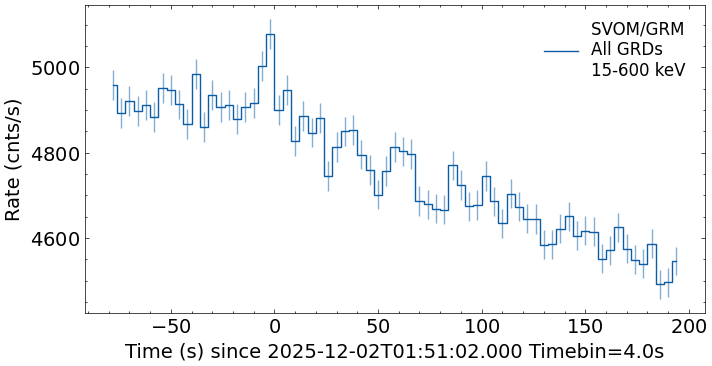
SVOM/GRM was triggered on-ground by EP251202a/GRB 251202A at 2025-12-02T01:51:02.000 UTC (T0), which is also detected by Fermi/GBM (Fermi GBM Team, GCN #42933 and #42957), Einstein Probe (Einstein Probe (EP) team, GCN #42934, #42937 and #42946), GOTO (GOTO collaboration, GCN #42947) and Insight-HXMT (Insight-HXMT team, GCN #42970).
With the event-by-event data downloaded through the X-band ground station, the GRM light curve shows that this burst consists of a single pulse with a T90 of 16 +8/-4 s in the 15-5000 keV band.
The SVOM/GRM light curve can be found here:
https://www.bursthub.cn//admin/static/svgrb251202A.png
In addition, the position of this burst, as determined by Swift-XRT (RA = 122.11512, Dec = 40.61228, GCN #42943), is located at about 134 degrees from the SVOM optical axis, which is outside the ECLAIRs field of view. ECLAIRs was not collecting data at the time of this burst.
The Space Variable Objects Monitor (SVOM) is a China-France joint mission led by the Chinese National Space Administration (CNSA, China), National Center for Space Studies (CNES, France) and the Chinese Academy of Sciences (CAS, China), which is dedicated to observing gamma-ray bursts and other transient phenomena in the energetic universe. GRM is developed by the Institute of High Energy Physics (IHEP) of CAS.
The SVOM point of contact for this burst is: Hao-Xuan Guo (IHEP)(guohx@ihep.ac.cn)

- GCN Circular #42999
M. Contreras, J. Basurto Merino, P.G. Berdayes, A. Caballero-Almagro, A. Cerón, F. Díaz-Segado, T. Ferrer-Laviña, B. Gandolfi, V. Ghiraldo, J. Hernández Fung, L. Juliá-Maroto, E. Lekaroz-Urriza, M. Manzano García, E. Mejía-Martínez, J. Prieto Polo, M. Pulido-Torres, M. Quintana-Ansaldo, A. Schenone-Zanuzzi, A. Selezneva, T. Tundidor Rodríguez, E. Urquijo-Rodríguez (all ULL), M. Abdul-Masih (IAC and ULL), and I. Pérez-Fournon (IAC and ULL).
We report on observations of the optical counterpart of GRB 251202A / EP251202a, detected by Fermi/GBM (Fermi GBM Team, GCN Circ. 42933; and Bala, GCN Circ. 42957), Einstein Probe (EP) (Zhang et al., GCN Circ. 42937; and Liang et al., GCN Circ. 42946), Swift-XRT (Sbarufatti et al., GCN Circ. 42943), AstroSat CZTI (Arya et al., GCN Circ. 42967), Insight-HXMT/HE (Guo et al., GCN Circ. 42970), and SVOM/GRM (Guo et al., GCN Circ. 42997).
We observed the field of GRB 251202A / EP251202a with the Las Cumbres Observatory (LCO) 40-cm telescope and one of the two LCO 1-m telescopes located at the LCO node at McDonald Observatory, Texas. The first observation, with the 40-cm telescope, started on 2025-12-02 at 06:29:14 UT, about 4.67 hours after the Fermi and EP trigger. The optical counterpart first reported by Li et al. (GCN Circ. 42934), at a spectroscopic redshift of z = 2.785 (Zhu et al., GCN Circ. 42939), is clearly detected in our images with the following AB magnitudes, calibrated against PanSTARRS-1 DR2 stars and not corrected for Galactic extinction:
 Date       |  UT start |  mag  | error | filter     | exposure time (sec) | telescope
---------------------------------------------------------------------------------------
2025-12-02     06:29:14   18.76   0.18    SDSS   r'         300               LCO 40-cm
2025-12-02     07:43:09   19.19   0.08    SDSS   g'         180               LCO 1-m
2025-12-02     07:46:39   18.91   0.07    SDSS   r'         180               LCO 1-m
2025-12-02     07:50:11   18.71   0.08    SDSS   i'         180               LCO 1-m
Our results are consistent with other UV and optical observations: Li et al. (GCN Circ. 42934), Lipunov et al. (GCN Circ. 42938), Zhu et al. (GCN Circ. 42939), O’Neill et al. (GCN Circ. 42947), Quirola-Vasquez et al. (GCN Circ. 42948), Kuin and Moss (GCN Circ. 42956), Zheng et al. (GCN Circ. 42964), Ma et al. (GCN Circ. 42966), and Bochenek et al . (GCN Circ. 42977).
This work makes use of observations from the Las Cumbres Observatory global telescope network (LCO program IAC2025B-010). These observations are part of a course in Astrophysical Techniques of the Master in Astrophysics of the Astrophysics Department of the University of La Laguna in collaboration with the Instituto de Astrofísica de Canarias (La Laguna, Tenerife, Canary Islands, Spain).
This work made use of the Astro-COLIBRI platform (P. Reichherzer et al. 2021, ApJS, 256, 5).
- GCN Circular #43128
S. Giarratana (INAF-OAB), M. Giroletti (INAF-IRA),
G. Ghirlanda (INAF-OAB), N. Di Lalla (Stanford Univ.),
N. Omodei (Stanford Univ.), O. S. Salafia (INAF-OAB),
L. Nava (INAF-OAB)
At 12:00:00 UT on 2025 December 5 (T_mid = 3.45 days post-burst)
the Karl G. Jansky VLA observed the field of GRB 251202A /
EP251202A (Fermi GBM team, GCN 42933, 42957; Einstein Probe team,
GCN 42937, GCN 42946; AstroSat CZTI collaboration, GCN 42967;
Insight-HXMT team, GCN 42970; SVOM team, GCN 42997) in three
bands, with central frequencies of 6, 10 and 15 GHz.
The standard 3C286 was used as bandpass and flux density
calibrator, while J0818+4222 was used as phase calibrator.
From a preliminary analysis, an unresolved radio source
is detected at a position (J2000):
RA: 08:08:27.466 +- 0.001
Dec: +40:36:44.70 +- 0.01
consistent with the X-ray (Einstein Probe team, GCN 42937;
Swift-XRT team, GCN 42943) and optical (GOTO collaboration,
GCN 42947; Quirola-Vasquez, GCN 42948; Swift/UVOT team,
GCN 42956; KAIT GRB team, GCN 42964; SVOM/VT team, GCN 42966;
Bochenek et al., GCN 42977; Contreras et al., GCN 42999)
position of the transient.
The preliminary analysis yields the following results:
================================================================
T_mid	Freq	Peak	r.m.s.	Beam		PA
[days]	[GHz]	[uJy/b]	[uJy/b]	[arcsec^2]	[deg]
================================================================
3.45	6	111	10	1.08x1.02	57
3.45	10	169	7	0.71x0.60	59
3.45	15	310	8	0.45x0.42	34
================================================================
No source is detected with a >3sigma confidence level at the
aforementioned position in the VLASS. However, the r.m.s. noise
level of the survey at the GRB location is approximately 130 uJy/b.
We would like to thank the staff of the VLA for approving, executing,
and processing the observations.
The National Radio Astronomy Observatory is a facility of the National
Science Foundation operated under cooperative agreement by Associated
Universities, Inc.
These observations were carried out as part of project SF181027,
approved in the framework of the Fermi - NRAO joint program agreement.
- GCN Circular #43142
A. A. Volnova (IKI), A. Novichonok (Petrozavodsk State University, KIAM), A. S. Pozanenko (IKI), N. S. Pankov (HSE, IKI) report on behalf of IKI-GRB-FuN:
We observed the field of GRB 251202A/EP251202a (Fermi GBM team, GCN 42933; Zhang et al., GCN 42937; Sbarufatti et al., GCN 42943; Liang et al., GCN 42946; Bala, GCN 42957; Arya et al., GCN 42967; Guo et al., GCN 42970, GCN 42997) with the Zeiss-1000 telescope of the Simeiz (Koshka) observatory (INASAN) taking several 90-second expositions in R-band starting on Dec.05 UT 21:38:48. In the stacked image we do not detect the optical counterpart reported previously (Zhu et al., GCN 42939; O’Neill et al., GCN 42947; Quirola-Vasquez et al., GCN 42948; Kuin and Moss, GCN 42956; Zheng et al., GCN 42964; Ma et al., GCN 42966; Bochenek et al., GCN 42977; Contreras et al., GCN 42999; Giarratana et al., GCN 43128). Preliminary photometry and observational details are the following:
Date        UT start  t-T0       Exp.    Filter  Obj.  Err.  UL       Site/Telescope
                     (mid,days)  (n*s)                      (3sigma)
2025-12-05  21:38:48  3.86988    68*90   R       n/d   n/d   19.7     Simeiz/Zeiss-1000
The photometry is based on several nearby stars from the USNO-B1 catalogue (R2 magnitudes) and is not corrected for the Galactic extinction.
- GCN Circular #43471
S. Giarratana (INAF-OAB), M. Giroletti (INAF-IRA),
G. Ghirlanda (INAF-OAB), N. Di Lalla (Stanford Univ.),
N. Omodei (Stanford Univ.), O. S. Salafia (INAF-OAB),
L. Nava (INAF-OAB)
At 11:52:30 UT on 2025 December 6 (T_mid = 4.45 days post-burst)
and at 11:34:42 UT on 2025 December 11 (T_mid = 9.43 days
post-burst) the Karl G. Jansky VLA observed the field of
GRB 251202A / EP251202A (Fermi GBM team, GCN 42933, 42957;
Einstein Probe team, GCN 42937, GCN 42946; AstroSat CZTI
collaboration, GCN 42967; Insight-HXMT team, GCN 42970;
SVOM team, GCN 42997) in three bands, with central frequencies
of 6, 10 and 15 GHz.
The standard 3C286 was used as bandpass and flux density
calibrator, while J0818+4222 was used as phase calibrator.
From a preliminary analysis, the radio source coincident with
GRB 251202A (Giarratana et al., GCN 43128) is detected at all
frequencies:
================================================================
T_mid	Freq	Peak	r.m.s.	Beam		PA
[days]	[GHz]	[uJy/b]	[uJy/b]	[arcsec^2]	[deg]
================================================================
4.45	6	99	7	1.07x1.02	54
4.45	10	169	7	0.72x0.60	65
4.45	15	296	9	0.45x0.42	34
9.43	6	118	7	1.06x0.95	-76
9.43	10	219	7	0.69x0.58	89
9.43	15	338	8	0.44x0.39	-74
================================================================
We would like to thank the staff of the VLA for approving, executing,
and processing the observations.
The National Radio Astronomy Observatory is a facility of the National
Science Foundation operated under cooperative agreement by Associated
Universities, Inc.
These observations were carried out as part of project SF181027,
approved in the framework of the Fermi - NRAO joint program agreement.
 Previous IAU Circulars